
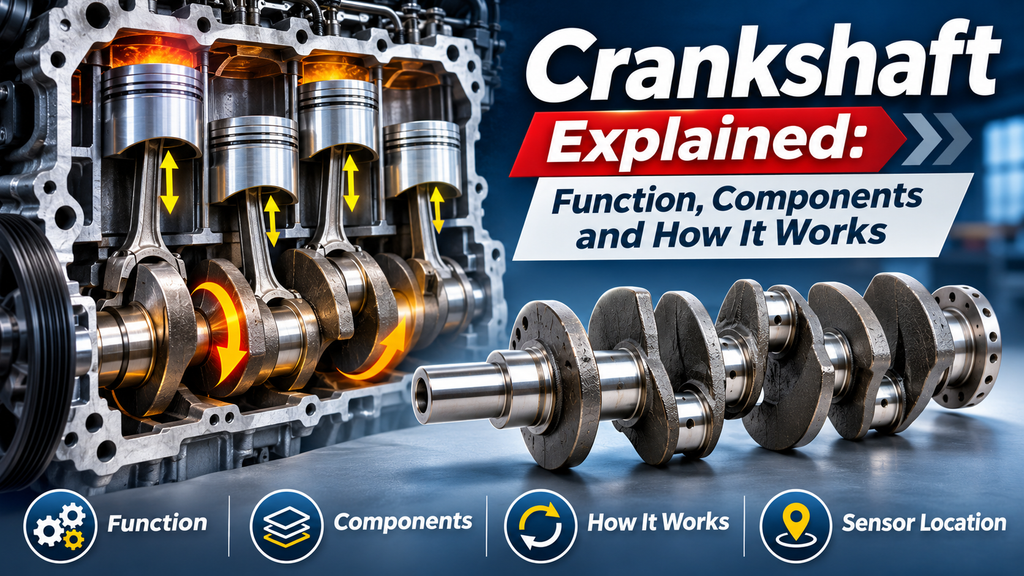
Every time you start your car, thousands of carefully timed mechanical movements take place inside its engine. Pistons travel up and down, connecting rods transfer force, and a rotating shaft helps turn that motion into useful power.
That rotating component is the crankshaft, one of the most important mechanical parts of a conventional internal combustion engine.
Without it, the pistons’ up-and-down movement could not be transferred into the rotational motion needed to drive the vehicle. The part must withstand combustion forces, rotational loads, and continuous operation while remaining precisely supported and lubricated.
This guide explains what the component does, how it works, its major parts, where it sits inside an engine, and how it differs from the camshaft. You’ll also learn where the related position sensor is commonly located and why sensor problems should not be confused with internal engine damage
Quick Answer: What Is a Crankshaft?
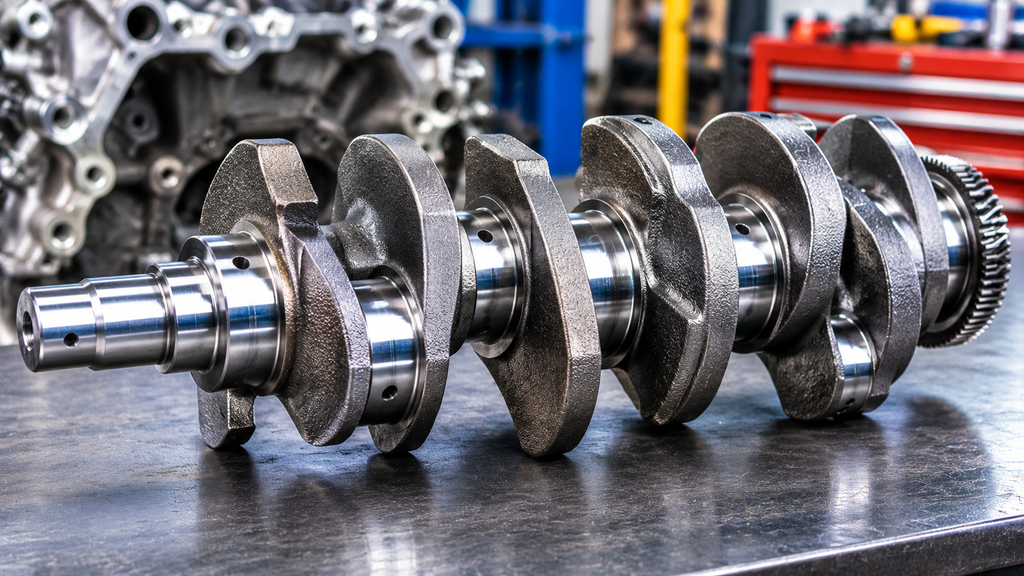
A crankshaft is a rotating metal shaft inside a piston engine that converts the pistons’ back-and-forth movement into rotational motion through connecting rods and offset crankpins. This rotation transfers engine power toward the transmission and ultimately helps drive the vehicle.
It is normally mounted in the lower portion of the engine, supported by main bearings, and connected to several important components, including the connecting rods and flywheel or flexplate.
1. What Is a Crankshaft in a Car Engine?
In mechanical engineering, a crankshaft is a shaft fitted with one or more offset crankpins that allow movement to be converted between reciprocating and rotational motion.
In a gasoline or diesel piston engine, combustion pressure pushes the pistons through their cylinders. Connecting rods transfer that force to the offset portions of the shaft, making it rotate.
Think of riding a bicycle. Your legs move through a repeating motion, while the pedals and crank mechanism create rotation that drives the bicycle forward.
A car engine uses a more complex, precisely engineered arrangement, but the underlying motion-conversion principle is similar.
Simple definition: The crankshaft transforms the reciprocating motion of engine pistons into rotational motion that can be used to transmit power.
Is Crank Shaft the Same as Crankshaft?
Yes. “Crank shaft” is a spaced variation sometimes used in searches, but crankshaft is the standard spelling used in most automotive technical documentation.
Do All Cars Have Crankshafts?
Conventional gasoline and diesel piston engines use crankshafts. Hybrid vehicles also have them when equipped with a piston-based internal combustion engine.
Fully battery-electric vehicles do not require a conventional engine crankshaft because their electric motors produce rotational motion directly.
2. What Does a Crankshaft Do?
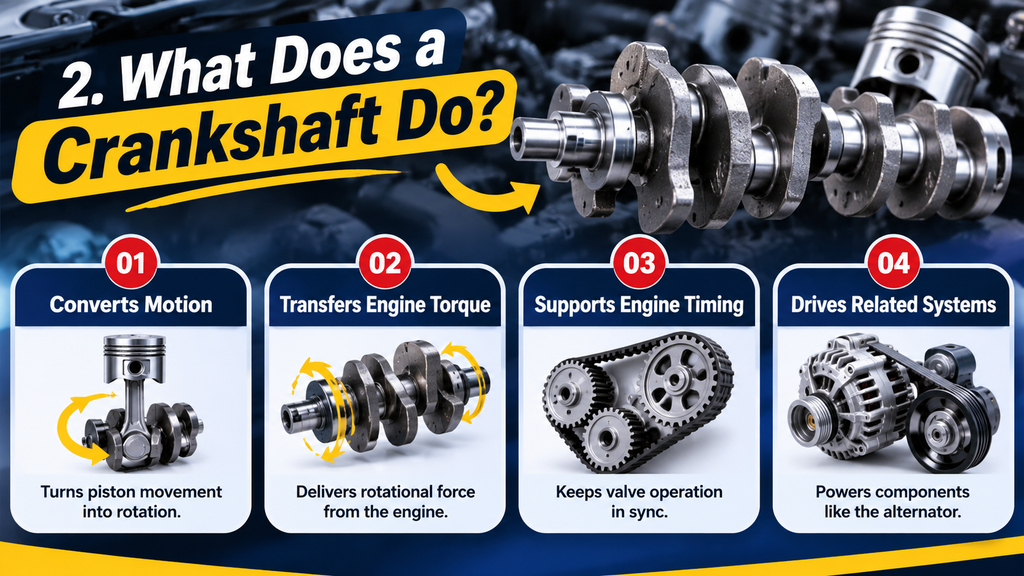
The main function is to convert the pistons’ linear motion into rotation. However, it also serves several related purposes inside the engine.
Converts Motion
Transforms piston movement into rotation through the connecting rods and offset crankpins.
Transfers Engine Torque
Delivers rotational force through the flywheel or flexplate to the transmission or driveline system.
Supports Engine Timing
Provides a mechanical rotational reference used to synchronize valve operation and other engine functions.
Drives Related Systems
Its rotation can drive timing components and belt-driven accessories through connected pulleys or gears.
How Does Engine Power Reach the Wheels?
Combustion creates force on a piston. The connecting rod transfers that force to the rotating shaft, which produces torque. The engine then transfers torque through the flywheel and clutch, or the flexplate and torque converter, depending on the transmission design.
Step 1
Combustion pushes the piston
Step 2
Connecting rod turns the crankshaft
Step 3
Torque passes through the driveline
The transmission, differential, and drive axles then help deliver power to the driven wheels. The exact arrangement depends on whether the vehicle uses front-wheel drive, rear-wheel drive, or all-wheel drive.
3. Main Parts of a Crankshaft and Their Functions
A crankshaft is not simply a straight piece of metal. Its design contains carefully machined bearing surfaces and offset sections that determine how the pistons move.
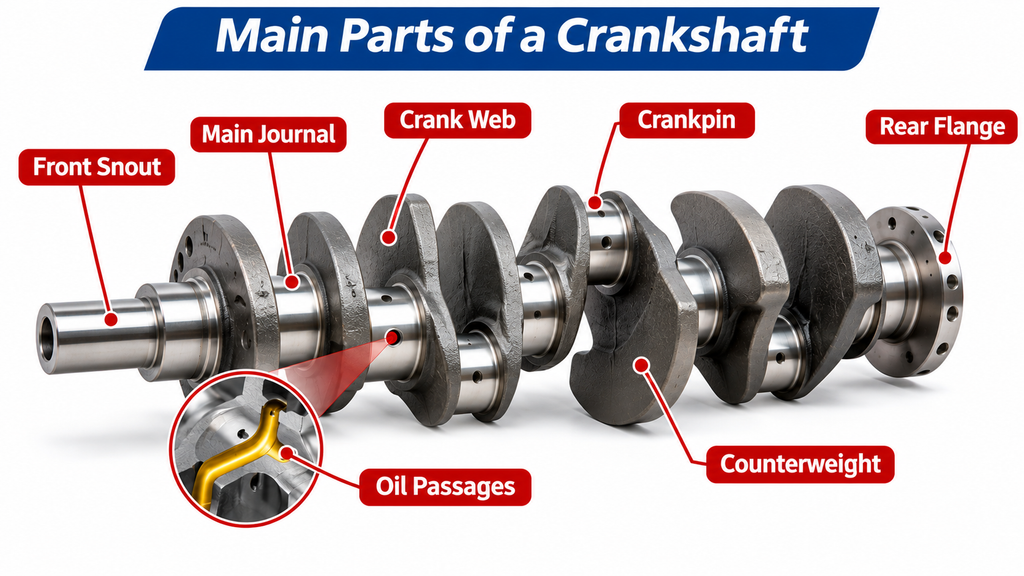
| Component | Function |
|---|---|
| Main Journals | Precisely machined cylindrical surfaces that rotate inside the engine’s main bearings and help support the shaft. |
| Crankpins | Offset journals where the large ends of connecting rods attach through rod bearings. |
| Crank Webs | Structural sections that connect the main journals to the offset crankpins. |
| Counterweights | Masses designed to help balance rotating forces and control vibration and bearing loads. |
| Oil Passages | Internal drilled passages that distribute pressurized engine oil to designated bearing surfaces. |
| Front Snout | Front end that may carry a crankshaft pulley, timing drive components, or vibration damper. |
| Rear Flange | Mounting location for the flywheel or flexplate. |
What Are Crankshaft Bearings?
The shaft rotates within bearings that support it while maintaining an oil film between moving surfaces. The main bearings support the shaft in the engine block, while connecting-rod bearings operate around the crankpins.
These bearings are separate components, not integral parts of the shaft itself. Their lubrication and clearances are essential for reliable engine operation.
Why Are Counterweights Important?
Pistons, connecting rods, and crankshaft components create changing forces during operation. Counterweights help manage rotating imbalance and reduce certain loads.
They do not eliminate every engine vibration. Depending on engine configuration, balancing shafts, flywheels, and torsional dampers may also contribute to smoother operation.
What Is a Crankshaft Vibration Damper?
Many engines have a vibration damper, sometimes called a harmonic balancer, mounted at the front of the crankshaft. Its purpose is to reduce torsional vibration caused by repeated combustion pulses.
A vibration damper is a separate component, and its specific design depends on the engine.
4. How Does a Crankshaft Work?
Understanding the operating process becomes easier when you follow the piston and connecting rod through one engine cycle.
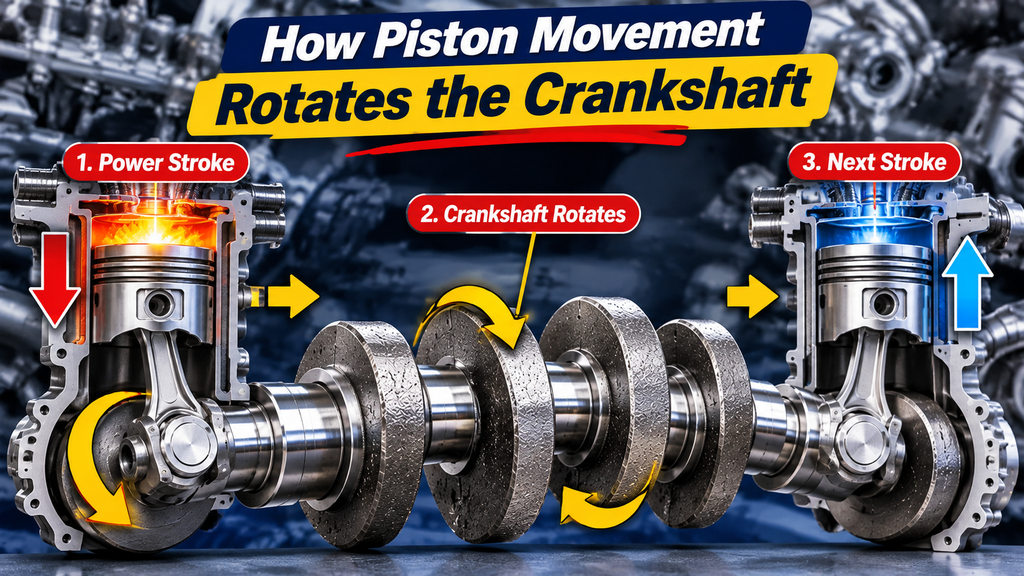
Step 1: The Piston Moves Inside the Cylinder
During engine operation, a piston moves back and forth along its cylinder. Its movement is transmitted through a connecting rod attached at one end to the piston and at the other end to a crankpin.
Step 2: The Connecting Rod Applies Force
When combustion pressure pushes the piston down during the power stroke, the connecting rod transfers that force toward the crankpin.
Because the crankpin is offset from the shaft’s main axis, the force can create torque and turn the shaft.
Step 3: The Shaft Continues Rotating
Not every stroke produces power. The rotating assembly’s inertia and, in multicylinder engines, power from other cylinders help the engine continue through its non-power strokes.
Step 4: Rotation Is Transmitted
The rotating shaft transfers torque toward the flywheel or flexplate and the transmission, allowing the engine’s mechanical output to move through the driveline.
The Four-Stroke Engine Cycle Explained
Most modern gasoline and diesel passenger-vehicle piston engines use a four-stroke operating cycle. The sequence involves intake, compression, power, and exhaust.
Intake Stroke
The piston moves down and the intake valve opens, allowing the engine’s intake charge to enter the cylinder.
Compression Stroke
The piston moves upward while the valves are closed, compressing the charge inside the cylinder.
Power Stroke
Combustion increases cylinder pressure, pushing the piston downward and delivering torque to the crankshaft.
Exhaust Stroke
The piston travels upward while the exhaust valve opens, helping expel combustion gases.
Important mechanical fact: A complete four-stroke cycle takes two crankshaft revolutions, or 720 degrees of rotation. In a conventional four-stroke engine, the camshaft normally completes one revolution during that same cycle.
How Many Times Does the Crankshaft Rotate?
Engine speed is normally expressed in revolutions per minute (RPM). For example, when the tachometer displays 2,000 RPM, the crankshaft is rotating approximately 2,000 times per minute.
At that speed, a given cylinder in a conventional four-stroke engine completes approximately 1,000 full four-stroke cycles per minute.
This relationship makes precise crankshaft position and engine speed measurements important for controlling combustion timing.
5. Where Is the Crankshaft Located in an Engine?
The crankshaft is generally installed in the lower section of a conventional piston engine, beneath the cylinders and pistons.
It rotates within the crankcase and is supported by main bearings secured within the engine structure.
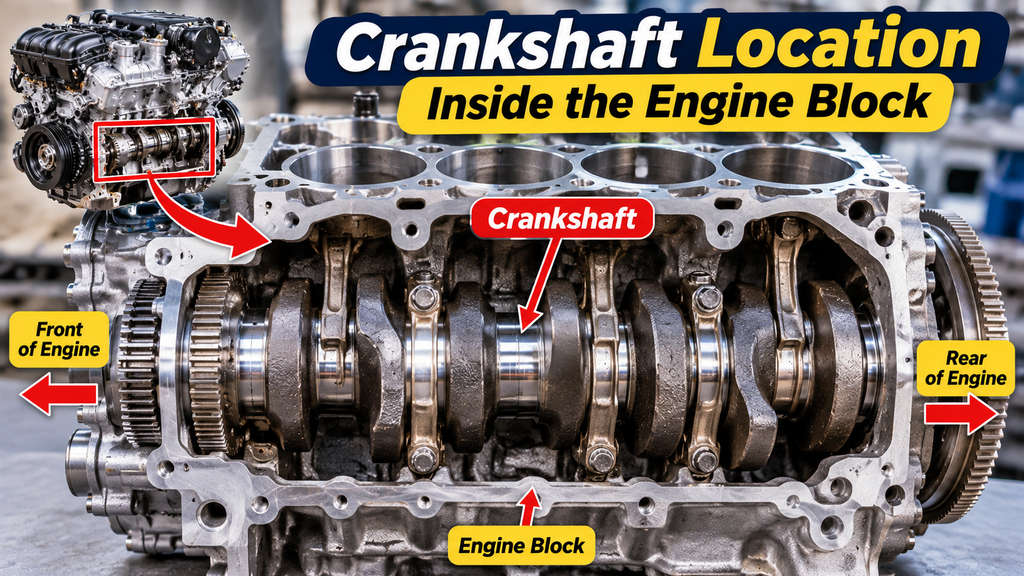
On many vehicle engines, the oil pan is attached beneath the crankcase. Although the shaft may sit above the oil pan, it should not be assumed to operate submerged in an oil reservoir. Pressurized oil is supplied to its bearings through dedicated lubrication passages.
Can You See It by Opening the Hood?
Usually, no. The majority of the crankshaft is enclosed inside the engine.
You may be able to see the crankshaft pulley or vibration damper at the front of the engine, but this does not expose the internal journals, crankpins, or connecting rods.
Inspecting the shaft directly generally requires significant engine disassembly, such as removing the oil pan and related components, depending on the vehicle and inspection procedure.
6. Types of Crankshafts and Common Materials
Crankshaft designs differ according to engine configuration, cylinder count, power output, manufacturing method, and intended operating conditions.
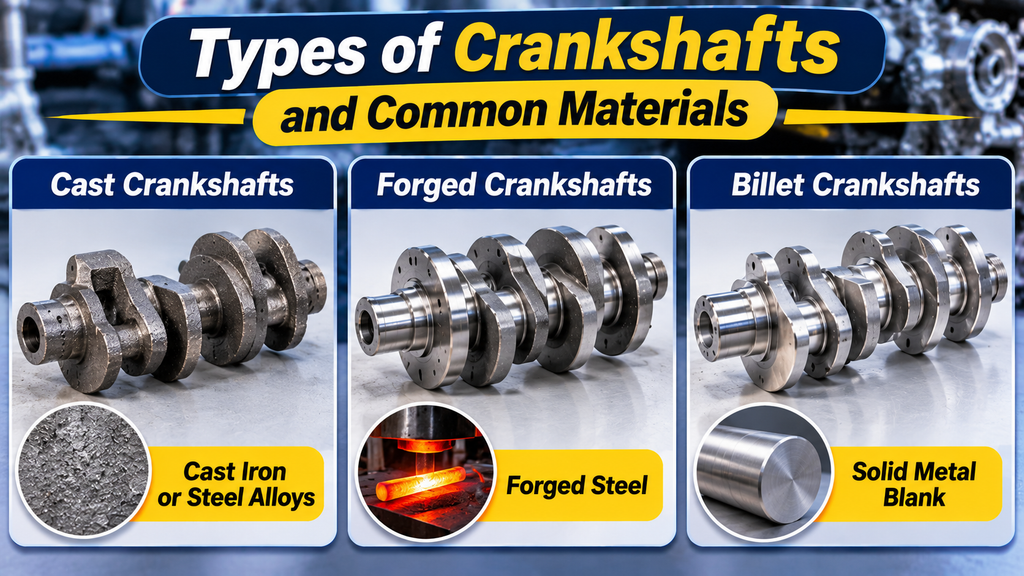
Cast Crankshafts
Cast shafts are made by pouring molten metal into a mold. Certain cast iron and steel alloys can provide suitable performance for applications that do not require the properties of more expensive forged designs.
Forged Crankshafts
Forged shafts are shaped from heated metal under pressure, creating a structure that can offer favorable strength and fatigue characteristics when properly designed and processed.
They are used in many applications where high loads and durability requirements justify their manufacturing cost.
Billet Crankshafts
Billet shafts are machined from a solid metal blank. They are commonly associated with specialized or performance-oriented applications where custom geometry is required.
| Manufacturing type | Typical characteristic | Common application |
|---|---|---|
| Cast | Cost-effective production for suitable designs and loads. | Various production engines. |
| Forged | Useful strength and fatigue properties with appropriate manufacturing. | High-load and performance applications, among others. |
| Billet machined | Allows specialized shapes and custom engineering. | Motorsport and custom engine builds. |
No manufacturing method automatically guarantees a better shaft in every application. Material selection, heat treatment, machining quality, geometry, and engine design all influence durability
7. Crankshaft vs. Camshaft: What’s the Difference?
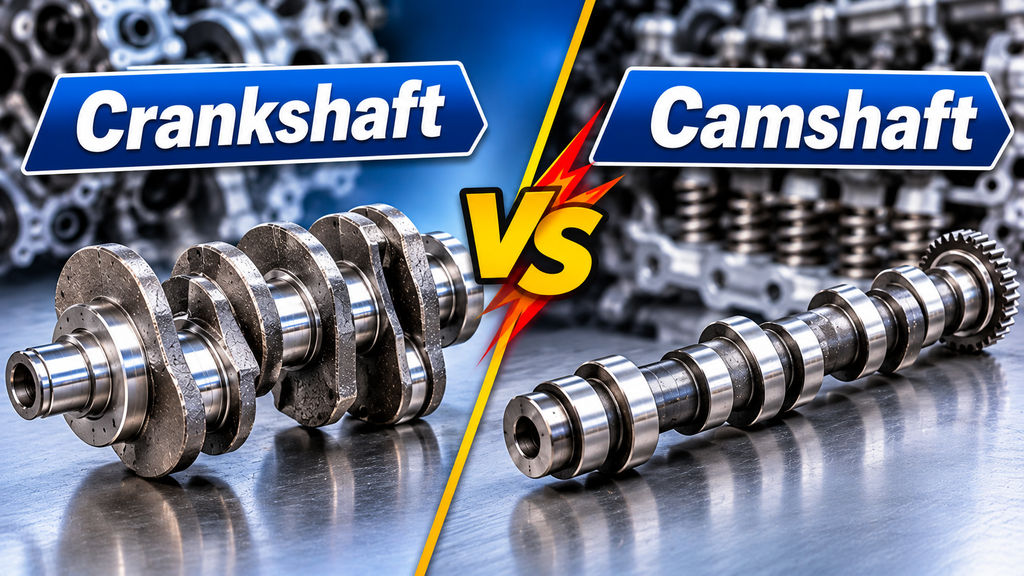
The crankshaft and camshaft are essential components in conventional four-stroke automotive engines, but they perform different jobs.
The crankshaft receives force from the pistons and produces rotation. The camshaft controls the opening and closing of engine valves through the valve train.
| Feature | Crankshaft | Camshaft |
|---|---|---|
| Main function | Converts piston movement into rotation. | Controls valve opening and closing. |
| Primary connection | Connecting rods and pistons. | Valve train components. |
| Typical location | Lower engine or crankcase. | Cylinder head or engine block, depending on design. |
| Rotation relationship | Two revolutions per four-stroke cycle. | Normally one revolution per four-stroke cycle. |
| Timing relationship | Provides the engine’s primary rotational reference. | Operates in synchronization with crankshaft rotation. |
How Are the Two Shafts Connected?
In many engines, a timing belt, timing chain, or gear system synchronizes the crankshaft and camshaft.
Correct synchronization ensures that valves open and close at the required points in the piston cycle.
Engine timing warning: Incorrect camshaft-to-crankshaft timing can cause serious mechanical problems. In interference engines, substantial timing errors may allow pistons and valves to collide.
8. What Is a Crankshaft Position Sensor?
The crankshaft position sensor, commonly abbreviated as CKP sensor, is an electronic engine-management component.
Its purpose is to detect crankshaft position and rotational speed, providing signals used by the engine control module (ECM) or powertrain control module (PCM).
The control module uses this information for functions such as fuel injection timing, ignition timing on applicable engines, and synchronization with other engine signals.
How Does the Sensor Work?
Many designs use a toothed or patterned reluctor wheel associated with the crankshaft. As the wheel moves past the sensor, the sensor produces an electrical signal that the engine computer interprets.
Common technologies include Hall-effect and inductive sensors. Their electrical behavior and testing procedures differ, so a diagnostic procedure suitable for one type may not work for another.
Is the Sensor Part of the Crankshaft?
No. The crankshaft is a mechanical rotating component. The CKP sensor is a separate electronic component that monitors its movement.
A malfunctioning sensor does not necessarily mean the crankshaft itself is damaged.
9. Where Is the Crankshaft Position Sensor Located?
The exact crankshaft position sensor location depends on the vehicle’s make, model, model year, and engine design.
It is often mounted on or near the engine block where it can detect a rotating target wheel associated with the crankshaft.
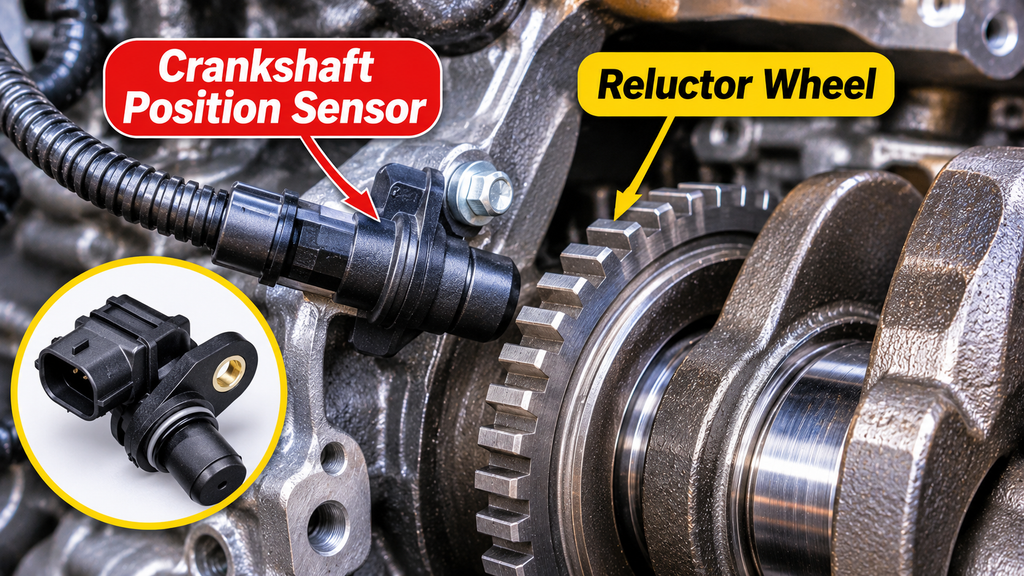
Three Common Sensor Locations
Near the Crankshaft Pulley
Some engines position the sensor near the front or accessory-drive end, where it monitors a crankshaft-associated target wheel.
Near the Flywheel
Other designs mount the sensor close to the rear of the engine or transmission bellhousing to detect a flywheel or flexplate target.
On the Engine Block
A sensor may be installed through the block or crankcase, positioned to detect an internal reluctor or trigger wheel.
How to Find the Correct Sensor on Your Vehicle
- Identify the vehicle: Record its year, make, model, engine size, and engine code when available.
- Find the service documentation: Look for the official CKP sensor location diagram or repair information for that engine.
- Confirm the component: Compare the documented position, connector, and mounting design rather than guessing based on appearance.
- Assess accessibility: Some sensors are visible from above, while others require access from beneath the vehicle or removal of surrounding parts.
- Follow the repair procedure: Use the manufacturer’s safety and installation instructions before disconnecting or replacing anything.
Safety warning: Do not reach near moving belts, pulleys, or a running engine while searching for a sensor. Allow hot components to cool. If access beneath the vehicle is required, use proper lifting equipment and approved support points. Never work beneath a vehicle supported only by a jack
Can You Replace the Sensor Yourself?
Replacement difficulty varies significantly. Some sensors are secured by a single accessible bolt, while others are located behind brackets, covers, or other engine components.
Correct installation may require a specific mounting procedure, attention to sensor clearance, electrical checks, or an engine-management relearn procedure, depending on the vehicle.
Do not replace the sensor solely because a scanner mentions a crankshaft-related fault.
10. Symptoms of Crankshaft and Position Sensor Problems
Mechanical crankshaft damage and electronic sensor faults can create very different repair situations.
Symptoms alone are not enough to distinguish them reliably, but understanding the possible patterns can help you communicate with a mechanic.
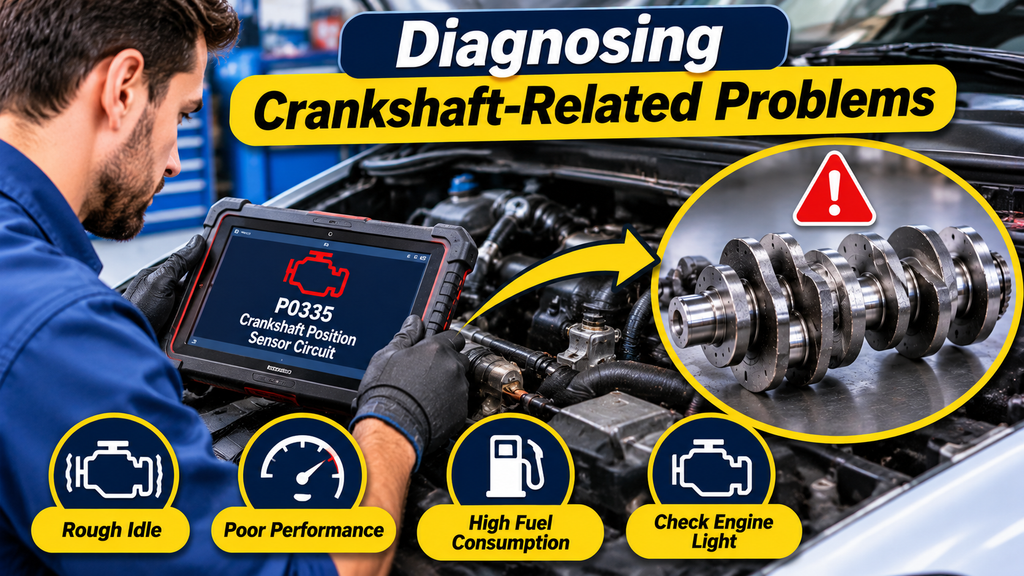
Possible Signs of a CKP Sensor or Circuit Problem
- Engine cranks but does not start.
- Intermittent stalling or difficulty restarting.
- Engine hesitation or misfiring under some conditions.
- Check engine light with a relevant diagnostic trouble code.
- Loss or irregularity of the expected engine-speed signal.
These symptoms can also result from ignition, fuel delivery, wiring, battery, timing, or other engine-management problems.
What Does Code P0335 Mean?
OBD-II trouble code P0335 generally indicates a crankshaft position sensor circuit malfunction.
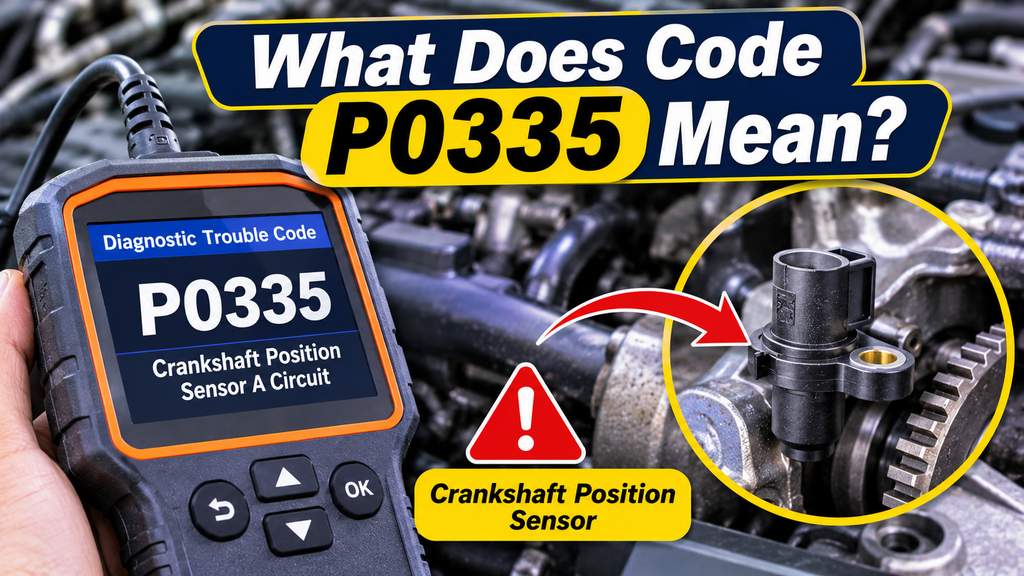
It does not prove the sensor itself has failed. Depending on the vehicle, potential causes may include a damaged connector, open or shorted wiring, a faulty sensor, a target-wheel issue, or an engine-control problem.
Other related trouble codes may involve signal range, performance, intermittency, or camshaft-to-crankshaft correlation.
Possible Signs of Internal Crankshaft or Bearing Damage
- Deep knocking noises that may change with engine speed or load.
- Low oil pressure or an oil-pressure warning.
- Metal particles found during oil or engine inspection.
- Abnormal vibration under certain operating conditions.
- Severe mechanical seizure or inability of the engine to rotate.
These signs are not exclusive to crankshaft failure. For example, a deep knock may originate from connecting-rod bearings, while abnormal vibration may result from engine mounts or other rotating components.
| Observation | Possible area to investigate | Recommended action |
|---|---|---|
| Cranks but will not start | CKP signal, electrical system, fuel, ignition, or timing. | Perform a structured no-start diagnosis. |
| Code P0335 | Sensor circuit, wiring, target wheel, or ECM inputs. | Follow vehicle-specific diagnostic tests. |
| Deep engine knock | Bearings, crankshaft, connecting rods, or other internal components. | Stop operation and seek professional assessment. |
| Low oil-pressure warning | Lubrication system or possible internal engine problems. | Safely stop and shut off the engine immediately. |
| Strong vibration | Multiple possible mechanical or powertrain causes. | Inspect and diagnose rather than replacing parts at random. |
11. What Causes Crankshaft Damage?
The crankshaft is engineered to withstand substantial loads, but it can still suffer wear or damage when operating conditions become severe.
Insufficient Lubrication
Low oil pressure, inadequate oil supply, contaminated oil, or an improperly maintained lubrication system can reduce the protective oil film around bearings.
This may cause bearing wear, excessive heat, damaged journals, and potentially severe internal engine failure.
Excessive Mechanical Loads
Abnormally high combustion loads, severe detonation, overspeed events, or mechanical interference can place excessive stress on engine components.
Incorrect Bearing Clearances
Improper bearing fitment or clearances during engine assembly may reduce lubrication performance or create harmful operating conditions.
Fatigue and Manufacturing Defects
Crankshafts experience repeated bending and torsional forces. Although properly designed components are built for long service life, fatigue cracks or manufacturing defects can sometimes contribute to failure.
Overheating and Related Engine Problems
Severe overheating or lubrication breakdown can damage bearings and associated internal components. The resulting friction or seizure can also harm the crankshaft.
12. Can a Damaged Crankshaft Be Repaired?
Whether a damaged crankshaft can be repaired depends on the type, location, and severity of the damage, as well as the engine manufacturer’s specifications.
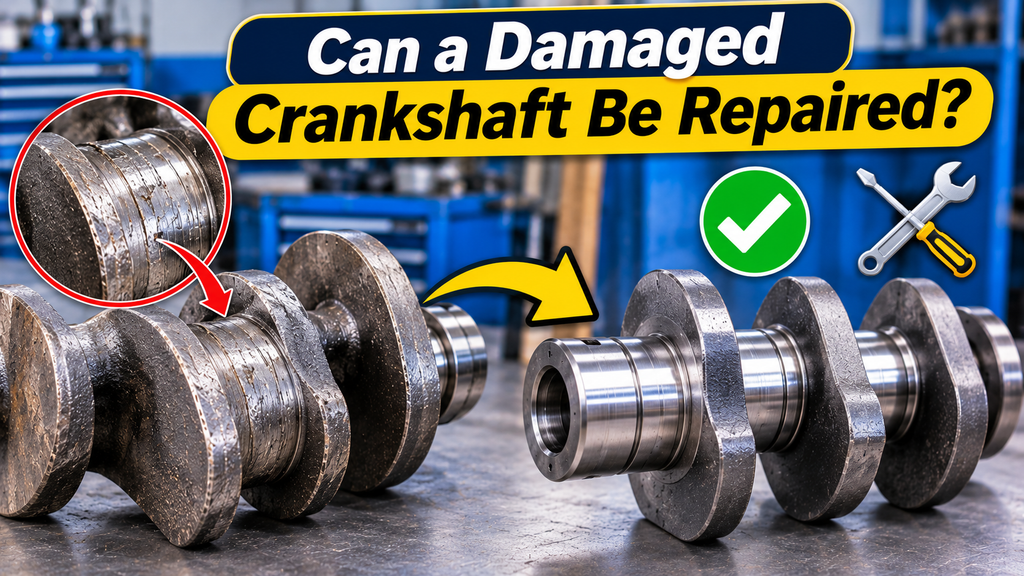
Some serviceable shafts can be polished or professionally reground when measurements and available bearing sizes permit. Others require replacement, especially if cracking, substantial distortion, or damage outside service limits is found.
What Does a Mechanic Inspect?
- Journal dimensions and surface condition.
- Signs of scoring, overheating, or bearing material transfer.
- Crankshaft straightness or runout where applicable.
- Evidence of cracks or structural damage.
- Oil passages and lubrication-related problems.
- Related bearings, connecting rods, and engine components.
Is Replacement Expensive?
Crankshaft replacement can be a major engine repair because the component is located inside the engine. Depending on vehicle design, substantial disassembly may be required.
Total cost depends on the vehicle, parts availability, labor requirements, the condition of surrounding components, and whether engine rebuilding or replacement is more practical.
A crankshaft position sensor replacement is a separate repair and may be far less involved, although accessibility and required procedures vary.
Repair decision: Before authorizing major engine work, ask the repair shop what measurements, diagnostic findings, or inspection results confirm the failure. A trouble code alone should not be used as proof that the crankshaft needs replacement.
13. How to Help Protect Your Engine’s Crankshaft
Because the crankshaft is located inside the engine, most owners cannot inspect it directly during routine maintenance. Instead, prevention focuses on protecting the lubrication system and avoiding harmful operating conditions.
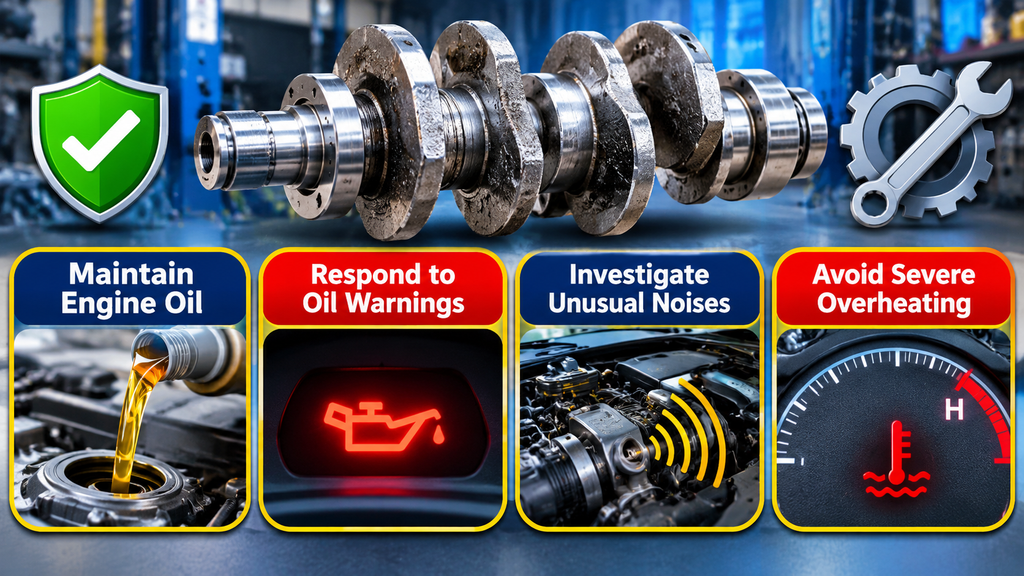
Maintain Engine Oil
Use the oil specification and service intervals recommended for your vehicle.
Respond to Oil Warnings
Safely stop and shut off the engine if the oil-pressure warning indicates a loss of lubrication.
Investigate Unusual Noises
Do not ignore new knocking, grinding, or serious mechanical noises.
Avoid Severe Overheating
Maintain the cooling system and respond promptly to temperature warnings.
How Long Does a Crankshaft Last?
There is no universal replacement interval for a crankshaft. In a properly maintained engine, it is generally intended to remain serviceable for a substantial portion of the engine’s operating life.
Actual durability depends on engine design, operating loads, oil condition, manufacturing quality, and overall maintenance
Crankshaft Troubleshooting Checklist
Use these questions before assuming that a crankshaft-related problem requires replacement:
- Is the issue mechanical, electrical, or still undetermined?
- Are there relevant stored diagnostic trouble codes?
- Has the engine oil level and lubrication condition been checked safely?
- Are there unusual knocking or grinding noises?
- Has the CKP sensor wiring and connector been inspected where appropriate?
- Has the sensor signal been evaluated using the correct procedure?
- Has a mechanic confirmed any internal damage through inspection or measurements?
- Does the proposed repair address the confirmed cause rather than only the symptoms?
Remember: A sensor-related fault and internal crankshaft damage are not interchangeable diagnoses.
Most Frequently Asked Questions About Crankshafts
1. What is a crankshaft in simple terms?
A crankshaft is a rotating metal component inside a car’s engine that converts the up-and-down movement of pistons into rotational motion. It connects to the pistons through connecting rods and transfers engine torque toward the transmission. Without a crankshaft, a conventional piston engine cannot convert combustion forces into usable rotational power.
2. What is the main function of a crankshaft?
The primary function of a crankshaft is to convert the reciprocating motion of engine pistons into rotational motion. It also transfers engine torque, helps drive timing components and accessories, and provides a rotational reference for engine management systems. Its design allows the engine to deliver smooth, continuous rotation.
3. Where is the crankshaft located in a car engine?
The crankshaft is typically located in the lower section of the engine block, beneath the pistons and cylinders. It rotates inside the crankcase and is supported by main bearings. Although the crankshaft itself is mostly enclosed, its front pulley or vibration damper may be visible in the engine compartment.
4. What are the main components of a crankshaft?
The main components include main journals, crankpins, crank webs, counterweights, oil passages, the front snout, and the rear mounting flange. Main journals support rotation, while crankpins connect to the connecting rods. Counterweights help balance rotating forces, and internal oil passages deliver lubrication to bearing surfaces.
5. How does a crankshaft work in a four-stroke engine?
In a four-stroke engine, the pistons move through intake, compression, power, and exhaust strokes. During the power stroke, combustion pushes the piston downward, transferring force through the connecting rod to an offset crankpin. This creates torque and rotates the crankshaft. A complete four-stroke cycle requires two crankshaft revolutions.
6. What is the difference between a crankshaft and a camshaft?
The crankshaft converts piston movement into rotational motion, while the camshaft controls the opening and closing of engine valves. In a conventional four-stroke engine, the crankshaft makes two complete revolutions for every one camshaft revolution. Both components must remain properly synchronized for the engine to operate correctly.
7. What is a crankshaft position sensor, and what does it do?
A crankshaft position sensor (CKP sensor) is an electronic component that monitors crankshaft speed and rotational position. It sends signals to the engine control module, which uses this information to manage ignition timing, fuel injection, and other engine functions. A malfunctioning sensor can cause starting difficulties, stalling, or engine performance problems.
8. Where is the crankshaft position sensor located?
The crankshaft position sensor location varies by vehicle make, model, and engine design. Common locations include near the crankshaft pulley, on the engine block, or close to the flywheel or transmission bellhousing. Consult your vehicle’s service manual to identify the exact location before attempting inspection or replacement.
9. What are the symptoms of a bad crankshaft position sensor?
Common symptoms include difficulty starting, intermittent stalling, engine hesitation, misfires, and an illuminated check engine light. Diagnostic trouble codes such as P0335 may indicate a problem with the crankshaft position sensor circuit. However, similar symptoms can result from wiring faults, ignition problems, fuel-system issues, or other engine components.
10. Can a car run with a damaged crankshaft?
A car may continue running with certain forms of early crankshaft or bearing damage, but operating it can lead to serious internal engine failure. Severe damage may prevent the engine from rotating altogether. If you hear deep knocking, experience abnormal vibration, or see a low oil-pressure warning, stop driving safely and arrange professional inspection.
11. What causes a crankshaft to fail?
Crankshaft failure can result from insufficient lubrication, worn bearings, excessive mechanical loads, engine overspeed, manufacturing defects, or metal fatigue. Low oil pressure and contaminated oil can accelerate bearing wear and damage crankshaft journals. Following manufacturer-recommended maintenance and responding promptly to unusual engine noises can reduce the risk of serious damage.
12. How much does it cost to repair or replace a crankshaft?
Crankshaft repair or replacement costs vary considerably depending on the vehicle, engine design, damage severity, labor rates, and parts availability. Minor journal damage may be repairable through professional machining, while severe cracking or distortion may require replacement. Because the component is located deep inside the engine, replacement often involves extensive labor and may make engine rebuilding or replacement worth considering.