
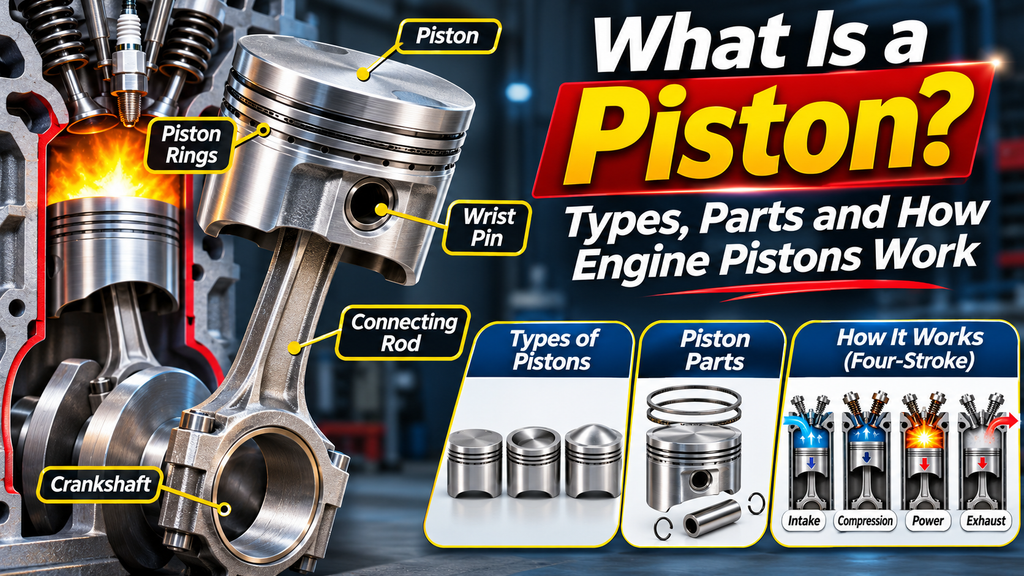
A car engine contains hundreds of moving parts, but the piston is one of the most important. Every time a gasoline or diesel engine runs, its pistons move inside the cylinders, helping convert the energy released during combustion into mechanical power.
A piston is a cylindrical engine component that moves up and down inside a cylinder. In a typical internal combustion engine, expanding gases push the piston downward. The connecting rod transfers this force to the crankshaft, which converts the piston’s back-and-forth movement into rotation.
Pistons also work with piston rings to help seal combustion pressure, control lubricating oil, and transfer heat. Their design and condition affect engine operation, making them essential to gasoline and diesel engines.
In this guide, you’ll learn the definition of a piston, its main parts, different piston types, how engine pistons work, and common problems that can develop over time.
Quick Answer: What Is a Piston?
A piston is a moving component that fits inside an engine cylinder. In an internal combustion engine, it helps compress the cylinder contents and receives force from expanding combustion gases. A connecting rod transfers that force to the crankshaft to produce rotating motion. Piston rings help seal the cylinder and regulate engine oil.
What Is a Piston? Definition and Meaning
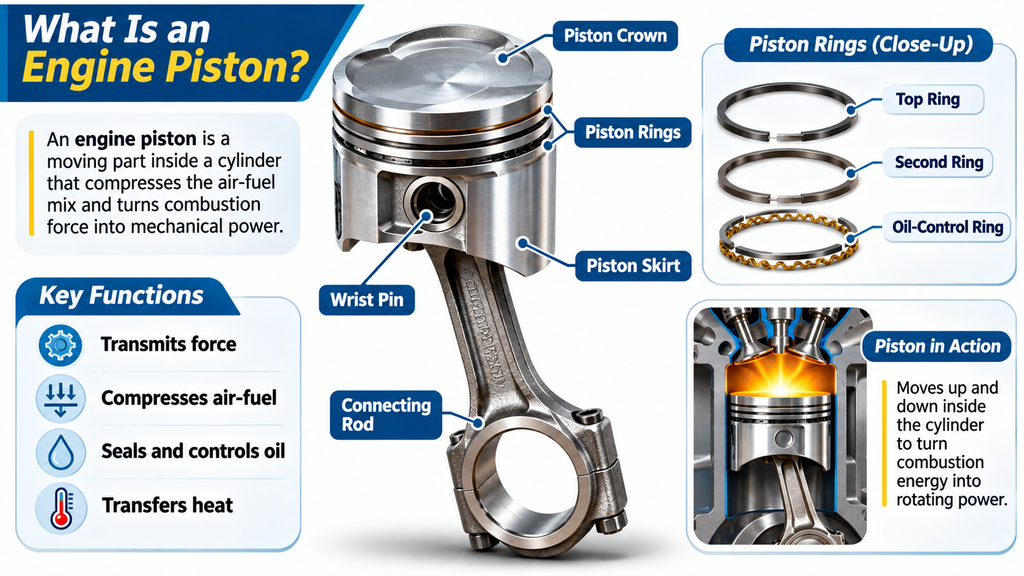
The simplest definition of a piston is a component that moves back and forth within a cylinder to transmit force or change the volume of an enclosed space.
Pistons are used in several types of machines, including engines, compressors, and pumps. However, when people discuss a car piston, they usually mean the component inside an internal combustion engine.
In a car engine, the piston travels along the cylinder bore. The piston crown faces the combustion chamber, while the piston skirt helps guide the component as it moves.
The piston connects to a connecting rod through a wrist pin. The other end of the connecting rod attaches to the crankshaft.
Simple explanation: Think of the piston as a closely fitted moving part inside a cylinder. Combustion pushes it in one direction, while the crankshaft and connecting rod control its repeated up-and-down movement.
Why Are Pistons Important?
An internal combustion engine cannot operate normally without functioning pistons. They help form the moving boundary of the combustion chamber and transmit the forces generated during the engine cycle.
Their rings, clearances, shape, and ability to handle heat all influence engine performance and reliability.
What Does a Piston Do in a Car Engine?
The main job of an engine piston is to transmit force between the gases inside the cylinder and the crankshaft mechanism. But a piston has several related functions.
Surface Properties
Texture, material composition, and microscopic surface interactions influence friction.
Normal Force
The force pressing surfaces together often affects friction. Greater normal force generally increases the available dry friction in simple models.
3. Works With Piston Rings
The rings help maintain combustion sealing and control the lubricating oil on the cylinder wall.
4. Transfers Heat
Heat moves through the piston, rings, cylinder wall, and surrounding oil. Some engine designs also use dedicated piston oil cooling.
A piston does not directly turn the wheels. The engine’s crankshaft produces rotational motion, which passes through other drivetrain components before reaching the driven wheels.
Where Is a Piston Located in an Engine?
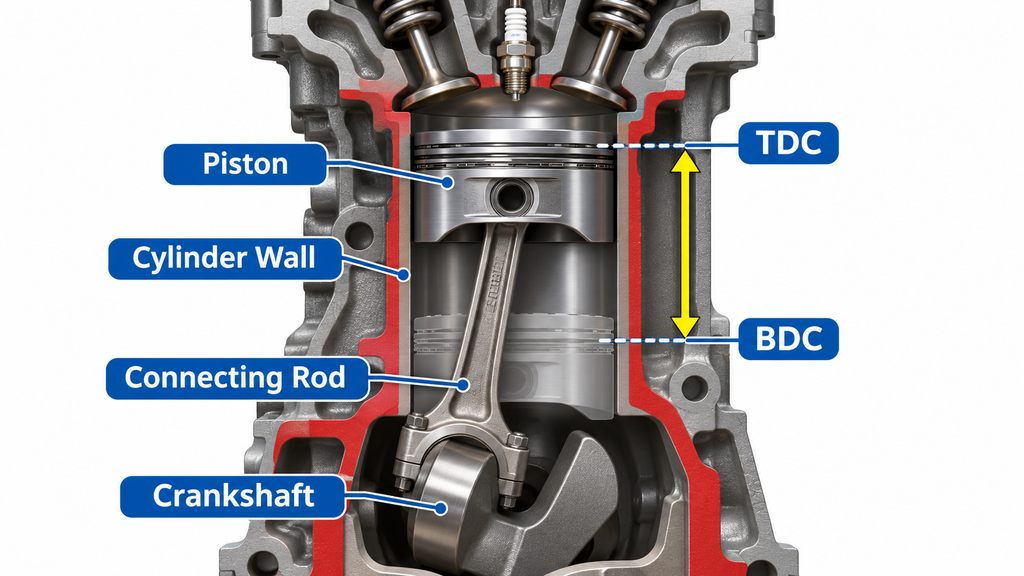
Pistons operate inside the cylinders of an internal combustion engine. In many modern passenger cars, the cylinders are formed within the engine block or cylinder liners.
The cylinder head closes the upper end of the cylinder and contains components associated with intake, exhaust, and combustion.
The piston moves between two main positions:
- Top Dead Center (TDC): The uppermost position of the piston.
- Bottom Dead Center (BDC): The lowermost position of the piston.
The distance traveled between TDC and BDC is called the stroke. It is an important engine dimension, along with the cylinder bore.
How Many Pistons Does a Car Engine Have?
In a conventional reciprocating automotive engine, there is generally one piston per cylinder. A three-cylinder engine typically has three pistons, a four-cylinder engine has four, a V6 has six, and a V8 has eight.
Cylinder arrangement and piston count are different concepts. An inline engine places cylinders in a row, while a V engine arranges them in two banks.
Main Parts of an Engine Piston
A piston may look like a simple metal cylinder, but its design includes several carefully engineered features. Each part must withstand heat, pressure, friction, or mechanical loading.
1. Piston Crown
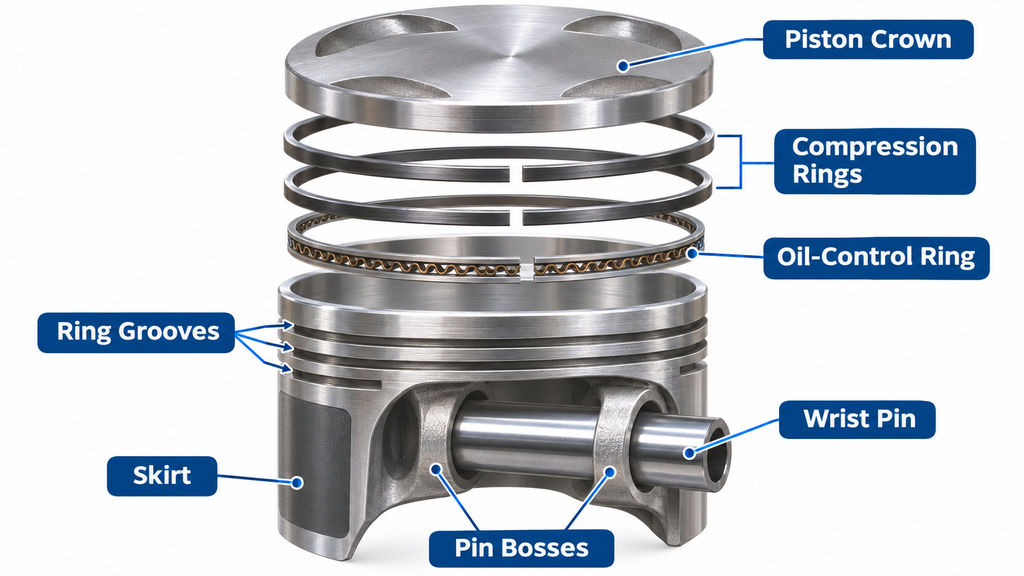
The piston crown is the top surface of the piston. It faces the combustion chamber and receives the force of expanding gases.
Its shape may be flat, recessed, raised, or otherwise contoured depending on the engine design.
2. Piston Skirt
The skirt extends below the ring area. It helps guide the piston within the cylinder and supports the side forces produced during engine operation.
3. Ring Grooves and Ring Lands
Ring grooves are machined channels that hold the piston rings. The material between neighboring grooves is called a ring land.
Correct groove geometry and clearances are important for ring movement and sealing performance.
4. Piston Rings
Piston rings fit into the grooves around the piston. They help seal combustion pressure, control lubricating oil, and transfer heat toward the cylinder wall.
5. Wrist Pin
The wrist pin, also called the piston pin or gudgeon pin, connects the piston to the small end of the connecting rod. It allows the rod to change angle as the crankshaft turns.
6. Pin Bosses
Pin bosses are reinforced internal areas surrounding the wrist-pin openings. They carry forces between the piston and the pin.
Important distinction: The connecting rod and crankshaft work with the piston, but they are not physical features of the piston body itself.
What Are Piston Rings and How Do They Work?
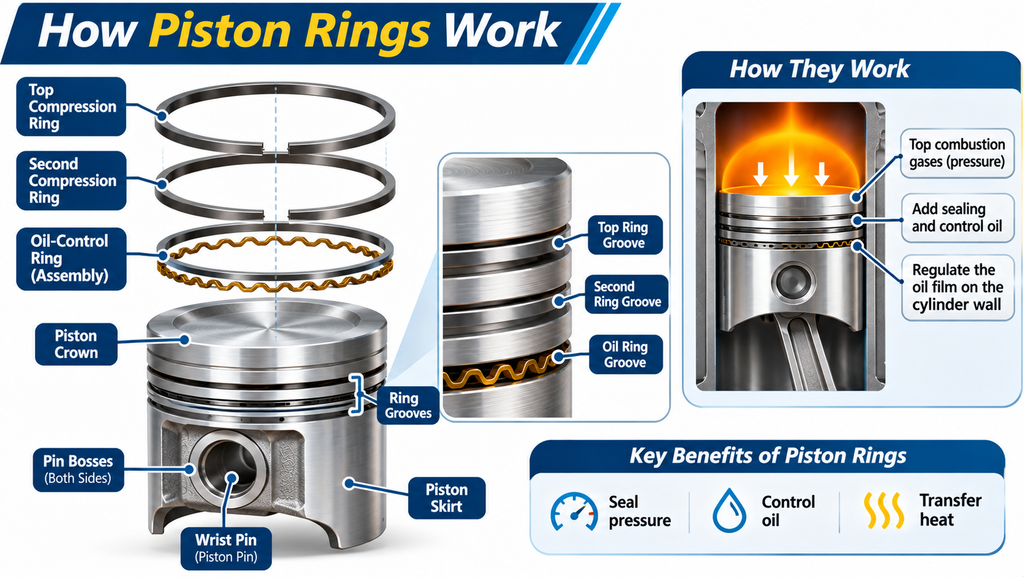
Piston rings are split metal rings installed around the piston. They maintain controlled contact with the cylinder wall.
Many four-stroke passenger-car engines use two compression rings and an oil-control ring assembly, although designs and ring counts can vary.
| Ring Type | Primary Function |
|---|---|
| Top Compression Ring | Helps seal combustion gases and transfer heat. |
| Second Ring | Provides additional gas sealing and assists with oil management. |
| Oil-Control Ring | Regulates the oil film on the cylinder wall and helps return excess oil. |
If a ring becomes worn, damaged, or stuck, sealing and oil control may deteriorate. However, symptoms associated with ring problems can also result from other engine faults.
How Does an Engine Piston Work?
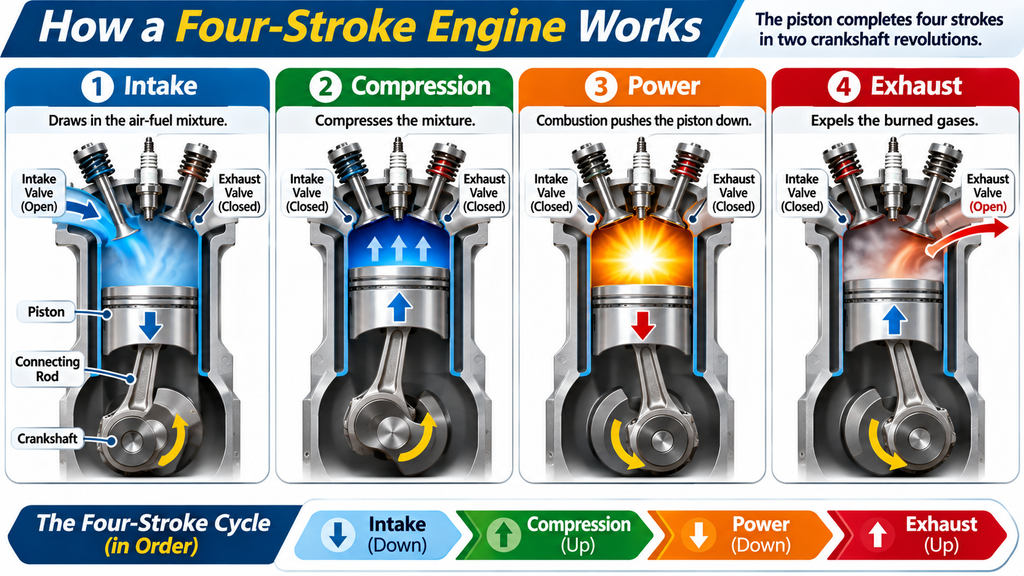
Most modern automotive gasoline engines use a four-stroke combustion cycle. This means the piston completes four strokes during two full crankshaft revolutions.
The four stages are intake, compression, power, and exhaust.
1. Intake Stroke
The intake valve opens and the piston moves downward. This increases the volume inside the cylinder, allowing air to enter. In many gasoline engines, fuel is mixed with the incoming air; in direct-injection designs, fuel delivery can occur at different times.
2. Compression Stroke
The piston moves upward as the cylinder contents are compressed. Reducing the chamber volume raises the pressure and temperature.
In a conventional spark-ignition gasoline engine, ignition occurs near the end of compression.
3. Power Stroke
The spark initiates combustion of the prepared air-fuel mixture. The resulting high-pressure gases push the piston downward.
The connecting rod transfers this force to the crankshaft, contributing to the rotating power produced by the engine.
4. Exhaust Stroke
The exhaust valve opens and the piston moves upward, helping push exhaust gases out of the cylinder. The operating cycle then repeats.
Four-Stroke Cycle Summary
Intake: Down → Compression: Up → Power: Down → Exhaust: Up.
How Is a Diesel Engine Different?
A four-stroke diesel engine uses the same basic piston movement sequence, but it typically compresses air rather than a premixed gasoline-air charge. Fuel injected into the hot compressed air ignites without a conventional spark plug initiating combustion.
Diesel pistons may have specially shaped combustion bowls to support air-fuel mixing and combustion.
How Does a Piston Turn Up-and-Down Motion Into Rotation?
The piston itself moves in a straight, reciprocating path inside the cylinder. The connecting rod links this motion to the offset crankpin on the crankshaft.
As the crankshaft rotates, the connecting rod changes angle. This mechanism allows the piston’s linear movement and the crankshaft’s rotation to remain connected.
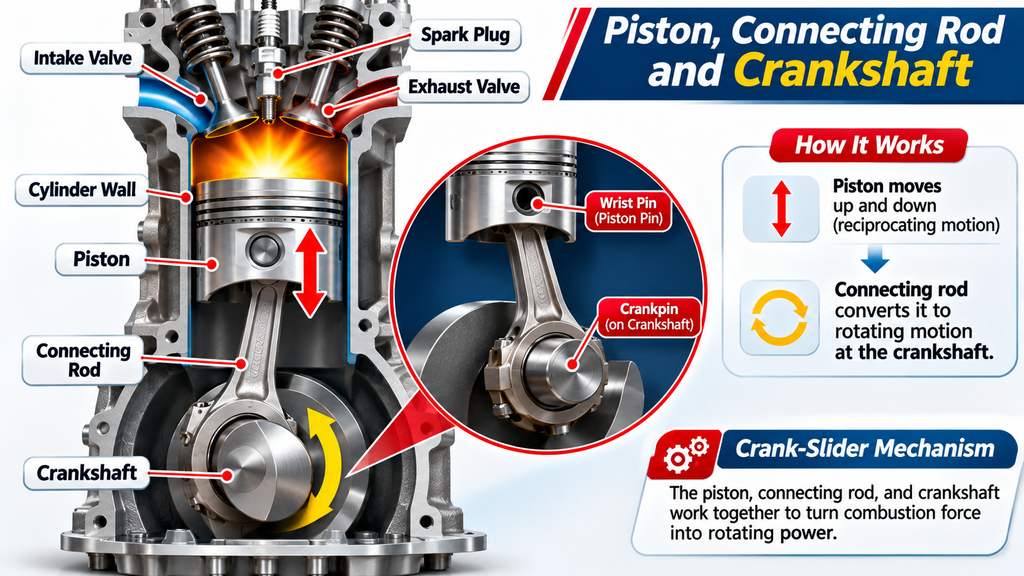
This is one reason proper lubrication and component alignment matter. The piston, pin, rod, bearings, and crankshaft all operate as parts of a coordinated mechanical system.
Different Types of Pistons Explained
Pistons vary in crown shape, construction, materials, and intended operating conditions.
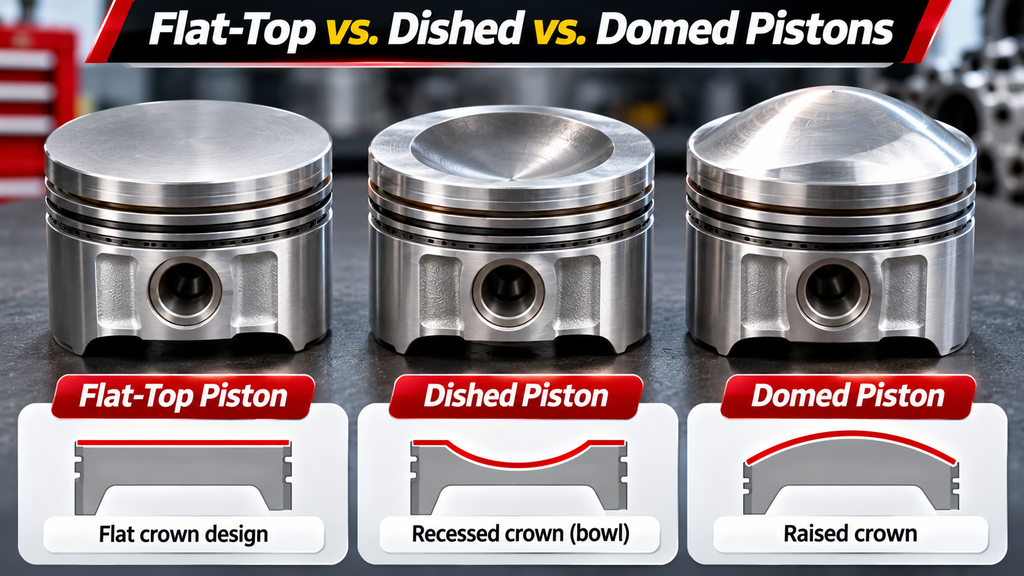
One useful way to compare piston designs is by the shape of the crown. Three commonly discussed designs are flat-top, dished, and domed pistons.
1. Flat-Top Pistons
A flat-top piston has a relatively flat upper surface, although some designs may include small valve reliefs or other features.
Its final effect on compression depends on the cylinder head, combustion chamber volume, gasket, clearances, and other dimensions.
2. Dished Pistons
A dished piston has a recessed area in its crown. This shape can contribute to the combustion chamber volume and may be used to achieve a particular compression or combustion design.
3. Domed Pistons
A domed piston has a raised section on its crown. The shape can change the available chamber volume and the relationship between the piston and cylinder head.
The actual compression ratio depends on the complete engine design, not piston shape alone.
| Piston Type | Crown Design | Key Consideration |
|---|---|---|
| Flat-top | Relatively flat | Combustion chamber geometry |
| Dished | Recessed crown | Chamber volume and combustion requirements |
| Domed | Raised crown | Compression and piston-to-head clearance |
What About Diesel Pistons?
Many diesel pistons use specially contoured crowns with combustion bowls. Their designs help manage airflow, fuel mixing, high pressure, and thermal loading.
Some diesel applications include reinforced ring areas and internal oil-cooling galleries.
What Are Engine Pistons Made Of?
Many passenger-car pistons are made from aluminum alloys because aluminum offers relatively low weight and good heat transfer.
Material selection also depends on strength requirements, operating temperature, piston dimensions, and engine design.
Cast Pistons
Cast pistons are produced by solidifying molten metal in a mold. Casting supports complex shapes and is widely used in many production engine applications.
Forged Pistons
Forged pistons are shaped using high mechanical pressure. Depending on the alloy and manufacturing process, forging can provide strength advantages for highly loaded applications.
However, a forged piston is not automatically the best choice for every engine. Clearances, expansion, coatings, weight, and intended use must all be considered.
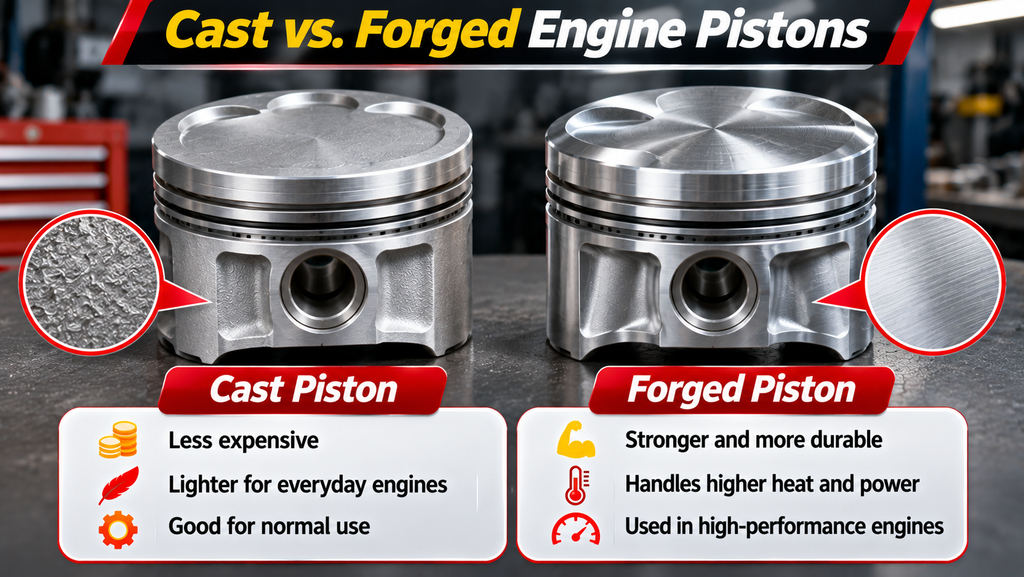
Remember: A piston can be both forged and flat-top, or cast and dished. The terms describe different design characteristics.
Piston vs. Piston Rings vs. Connecting Rod
These components work together, but each performs a different task. Understanding their roles makes engine operation easier to follow.
| Component | Main Function |
|---|---|
| Piston | Transmits cylinder force and changes cylinder volume. |
| Piston Rings | Help seal combustion gases, manage oil, and transfer heat. |
| Wrist Pin | Connects the piston to the connecting rod. |
| Connecting Rod | Transfers forces between the piston and crankshaft. |
| Crankshaft | Converts reciprocating piston movement into rotation. |
A problem in one component can affect other parts of the assembly. For example, inadequate lubrication may damage more than one moving surface.
What Causes Engine Piston Damage?
Pistons operate under repeated mechanical and thermal stress. Engine design, maintenance, lubrication, combustion quality, and operating conditions all affect their service life.
1. Overheating
Excessive temperature can cause abnormal expansion, surface damage, or accelerated wear. Severe overheating may affect pistons, rings, and cylinder walls.
2. Insufficient Lubrication
Engine oil helps reduce friction and remove heat. Inadequate lubrication can increase metal contact and damage sliding surfaces.
3. Abnormal Combustion
Conditions such as severe detonation or pre-ignition can expose piston components to damaging pressure and temperature loads.
These are distinct combustion phenomena and require proper diagnosis.
4. Wear or Incorrect Clearances
Excessive wear, incorrect component clearances, assembly errors, or damaged rings may interfere with normal piston movement and cylinder sealing.
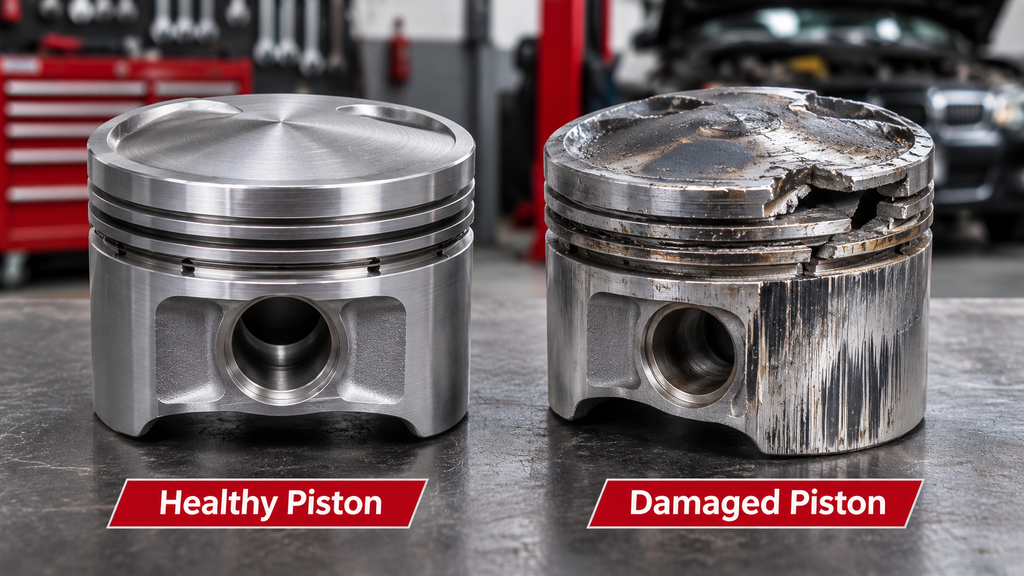
Common Symptoms of Piston or Piston-Ring Problems
Some engine symptoms may point toward piston or piston-ring problems. However, the same symptoms can have several other possible causes.
| Symptom | Possible Concern | Important Note |
|---|---|---|
| Blue exhaust smoke | Oil entering combustion chamber | May involve rings, valve seals, turbocharger, or other faults |
| Low compression | Poor cylinder sealing | Valves and head gasket may also be involved |
| High oil consumption | Oil-control problem | External leaks and other causes need checking |
| Unusual knocking | Potential mechanical or combustion issue | Sound alone cannot identify the failed part |
| Loss of power | Possible compression or combustion issue | Fuel, ignition, air, and other systems can cause similar symptoms |
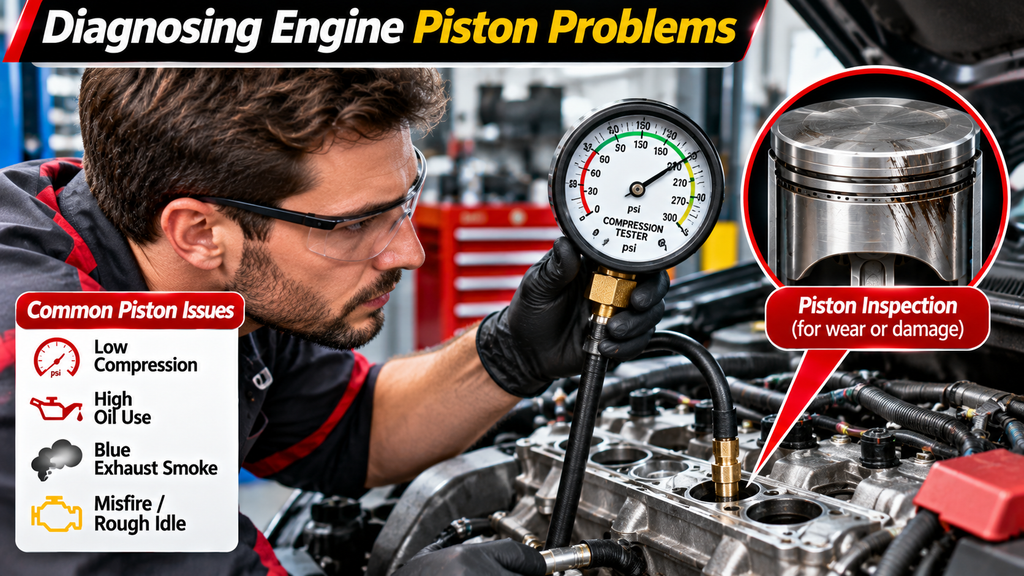
How Do Mechanics Diagnose Piston Problems?
A qualified technician may use a combination of inspections and tests, depending on the vehicle and symptoms.
- Compression testing: Checks cylinder pressure during cranking.
- Leak-down testing: Helps identify where a cylinder is losing sealing pressure.
- Borescope inspection: Allows visual examination of some internal cylinder surfaces.
- Engine oil and cooling-system checks: Help identify related operating problems.
- Mechanical inspection: May be necessary when tests suggest internal damage.
Safety note: Severe knocking, overheating, low oil-pressure warnings, or sudden engine power loss may indicate problems requiring immediate attention. Stop driving when safe and consult the owner’s manual and a qualified technician. Continuing to operate a damaged engine can cause additional harm.
Can a Damaged Piston Be Repaired?
The appropriate repair depends on what is damaged and whether other engine components have also been affected.
If the problem is limited to worn piston rings, a technician may consider ring replacement after checking piston grooves, cylinder condition, and relevant clearances.
Cracked, severely scuffed, or structurally damaged pistons typically require replacement. Associated cylinder, bearing, and connecting-rod damage must also be evaluated.
A major internal engine repair may require significant disassembly, precision measurements, and specialized equipment.
How Much Does Piston Repair Cost?
There is no reliable universal piston repair price. Costs depend on the engine design, vehicle, damage severity, labor rates, parts availability, and whether machining or engine replacement is needed.
A proper diagnosis and written repair estimate are more useful than assuming a fixed cost based on symptoms alone.
How Can Drivers Help Protect Engine Pistons?
- Follow the manufacturer’s oil specification and service schedule.
- Address cooling-system problems promptly.
- Use the fuel grade recommended by the manufacturer.
- Investigate persistent engine knocking or unusual noises.
- Do not ignore oil-pressure or overheating warnings.
- Keep maintenance records and follow the owner’s manual.
Good maintenance reduces some avoidable risks, but normal wear and unexpected mechanical failures can still occur.
Frequently Asked Questions About Pistons
1. What is a piston in simple words?
A piston is a moving component inside a cylinder. In a car’s combustion engine, it helps compress the cylinder contents and transfers combustion force through a connecting rod to the crankshaft.
2. What does a piston do in a car engine?
A piston moves up and down in the engine cylinder, helping compress the cylinder contents and transmit force generated during combustion. Together with the connecting rod, it helps drive the crankshaft.
3. How many pistons does a car engine have?
A conventional reciprocating car engine usually has one piston per cylinder. For example, a four-cylinder engine generally has four pistons, while a V6 has six and a V8 has eight.
4. What are the main parts of a piston?
The main features of a piston include the crown, skirt, ring grooves, ring lands, and wrist-pin bosses. Piston rings and the wrist pin are important associated assembly components.
5. What are the three common piston crown shapes?
Three commonly discussed piston crown designs are flat-top, dished, and domed. Their shapes influence combustion chamber geometry, but their actual effects depend on the complete engine design.
6. What is the difference between a piston and a piston ring?
The piston is the main moving component inside the cylinder. Piston rings fit around the piston and help maintain combustion sealing, regulate oil, and transfer heat.
7. What happens when a piston is damaged?
Depending on the damage, the engine may develop poor compression, unusual noise, oil consumption, misfires, or reduced power. These symptoms are not specific to piston failure, so proper diagnosis is necessary.
8. Can an engine run with a broken piston?
An engine may sometimes continue running with certain internal damage, but operation can be rough, unreliable, or dangerous to other engine components. A suspected broken piston requires professional evaluation, and the engine should not be kept running to test it.
9. Do electric cars have engine pistons?
Battery-electric cars do not use reciprocating combustion engine pistons for propulsion. Their electric motors produce rotating power through electromagnetic action. Plug-in hybrids and conventional hybrids may still have pistons in their combustion engines.
10. What does pistoning mean?
In a general mechanical context, pistoning can describe repeated back-and-forth movement similar to that of a piston. In automotive explanations, the more precise term is often reciprocating motion. The word can have different meanings in other fields.
Final Thoughts: Understanding Engine Pistons
An engine piston is more than a piece of metal moving inside a cylinder. It is a precisely engineered component that helps convert combustion energy into mechanical power.
Its crown receives combustion force, its skirt helps guide movement, and its rings support sealing and oil control. The connecting rod transfers force to the crankshaft, which produces rotational motion.
Understanding piston parts, design differences, and common failure causes makes it easier to understand how gasoline and diesel engines work.
Key takeaway: A piston moves back and forth inside an engine cylinder, transferring force through the connecting rod to the crankshaft. Piston design, lubrication, temperature control, and ring condition all matter for proper engine operation.