
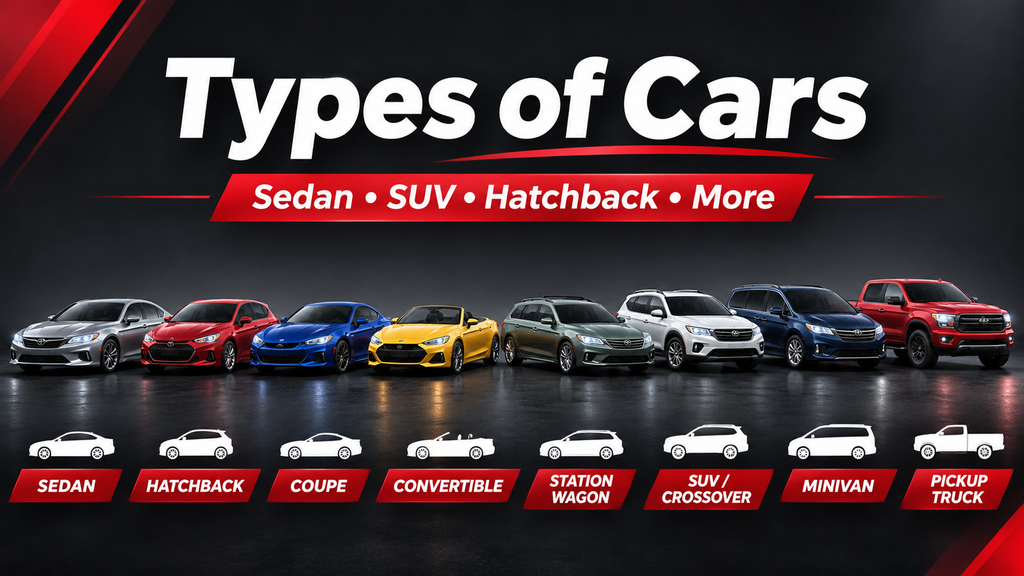
Cars come in many shapes and sizes, from compact hatchbacks and family sedans to spacious SUVs, pickup trucks, and convertibles. But how many types of cars are there, and what makes each type different?
The most common car body styles include sedans, hatchbacks, coupes, convertibles, station wagons, SUVs, crossovers, minivans, and pickup trucks. Each has different design characteristics, passenger arrangements, and cargo capabilities.
Vehicles can also be categorized by their size, purpose, powertrain, and drivetrain. That means an electric vehicle, a luxury car, and an SUV are not necessarily three separate body styles.
This guide explains the different types of automobile cars using recognizable examples, straightforward comparisons, and practical buying advice to help you understand which vehicle categories suit different needs.
Quick Answer
What are the different types of cars? The major everyday body styles are sedans, hatchbacks, coupes, convertibles, station wagons, SUVs, crossovers, minivans, and pickups. Other descriptions, such as sports cars, luxury cars, electric cars, and compact cars, refer to performance, market position, powertrain, or size rather than a completely separate body shape.
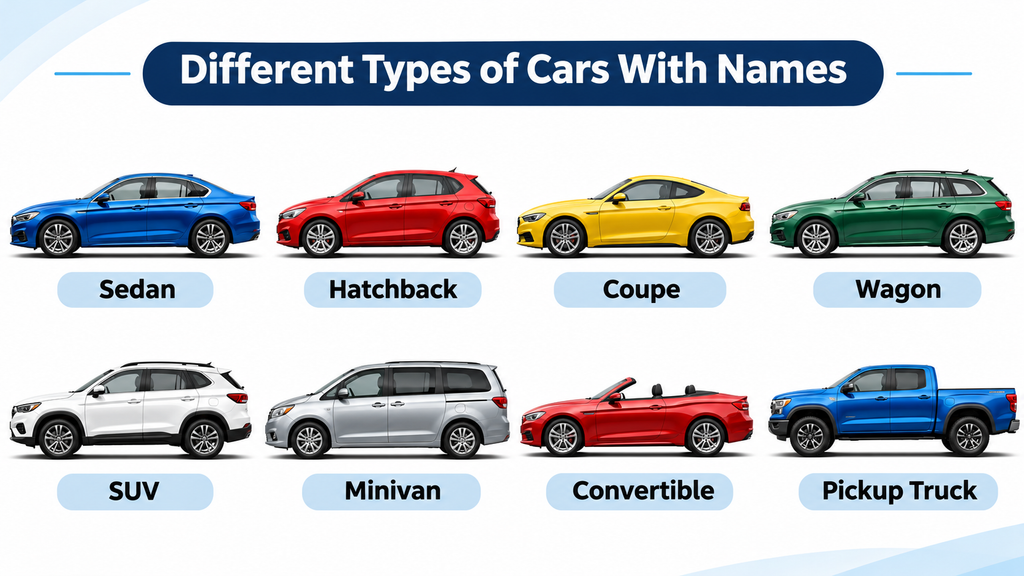
What Are the Different Types of Cars?
A car body style describes the overall shape and structure of a vehicle. Important features include the roofline, door arrangement, passenger compartment, and type of cargo access.
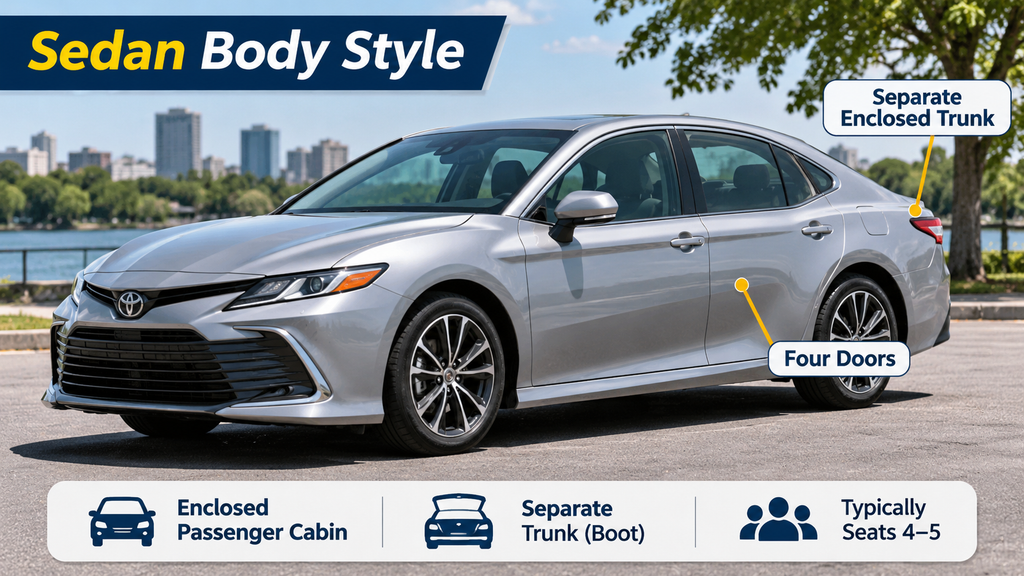
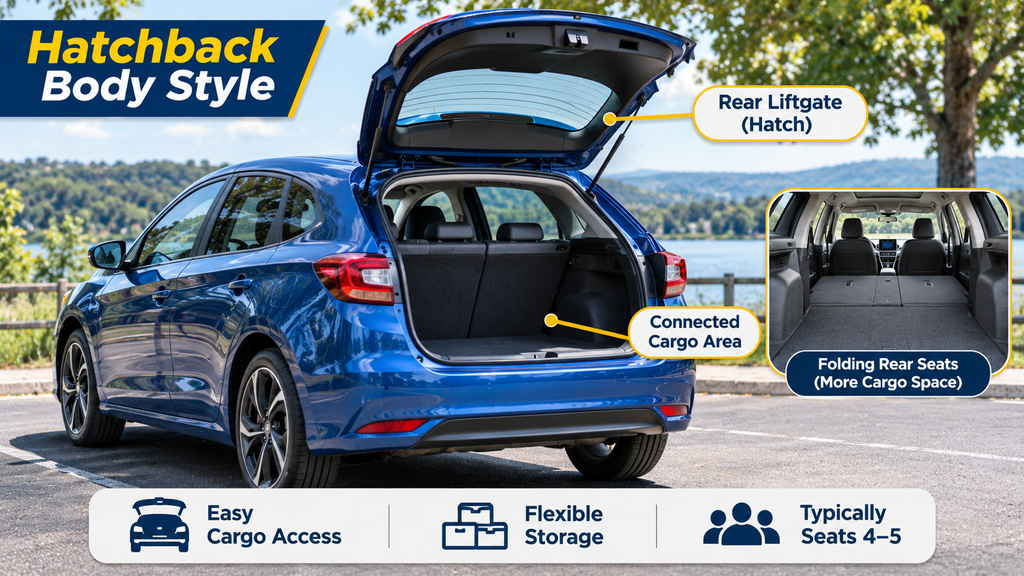
For example, a sedan generally has an enclosed trunk separated from the passenger cabin. A hatchback has a rear door that lifts upward to access a cargo area connected to the cabin. An SUV usually has a taller body and an elevated driving position.
These distinctions help buyers understand different kinds of automobiles without relying only on brand names or appearance.
Types of Cars Names and Main Features
| Car Type | Identifying Feature | Typical Use |
|---|---|---|
| Sedan | Separate enclosed trunk | Daily commuting |
| Hatchback | Rear liftgate | City driving and cargo flexibility |
| Coupe | Sporty roofline, traditionally two doors | Style and personal driving |
| Convertible | Opening or removable roof | Open-air driving |
| Wagon | Long roof and rear cargo area | Passenger and luggage space |
| SUV | Taller body and flexible interior | Families and varied driving needs |
| Crossover | SUV-like shape, generally unibody | Everyday versatility |
| Minivan | Sliding doors and flexible seating | Family transportation |
| Pickup | Open cargo bed | Carrying equipment and loads |
There is no universally fixed number of car types. Manufacturers, automotive websites, and regulatory agencies may classify the same vehicle differently depending on their purpose.
1. Sedan Cars
A sedan is a passenger car traditionally designed with four doors, an enclosed passenger cabin, and a separate trunk. Sedans are among the most recognizable car body styles.
Sedans are commonly available in compact, midsize, and full-size categories. They are often considered by commuters, small families, and drivers who want a conventional passenger vehicle.
The Toyota Camry and Honda Civic Sedan are familiar examples.
Advantages of Sedans
- Familiar driving position and car-like handling.
- Various sizes and price categories are available.
- Separate trunk keeps luggage apart from the main cabin.
- Suitable for many commuting and highway-driving needs.
Limitations of Sedans
A sedan’s trunk opening can make transporting large or awkwardly shaped items more difficult. Drivers seeking taller seating positions or substantial cargo flexibility may prefer a crossover, SUV, or hatchback.
Best suited for: Commuters, small families, and drivers who prefer a conventional passenger-car layout.
2. Hatchback Cars
A hatchback has a rear door that opens upward to provide access to the cargo area. Unlike a traditional sedan, its cargo space is generally part of the main enclosed interior.
Many hatchbacks have folding rear seats, allowing drivers to expand the usable cargo area when they are not carrying rear-seat passengers.
The Volkswagen Golf and Honda Civic Hatchback are recognizable examples of this design.
Why Choose a Hatchback?
Hatchbacks can be practical for urban driving, shopping, commuting, and carrying moderately bulky items. Their upward-opening rear door often allows easier loading than a traditional sedan trunk.
However, cabin space, fuel economy, and parking convenience depend on the specific vehicle’s dimensions and design.
Best suited for: City drivers, commuters, and people who want a compact car with flexible cargo access.
3. Coupe Cars
A coupe is traditionally a two-door passenger car with a fixed roof. Coupes are often associated with stylish proportions, a lower roofline, and a more driver-focused design.
Some coupes have small rear seats, while others are designed primarily for two occupants. Depending on the model, performance can range from ordinary road driving to high-performance sports use.
The Ford Mustang coupe is a familiar example. Manufacturers also use terms such as “four-door coupe” for some sleek sedans, even though this differs from the traditional two-door definition.
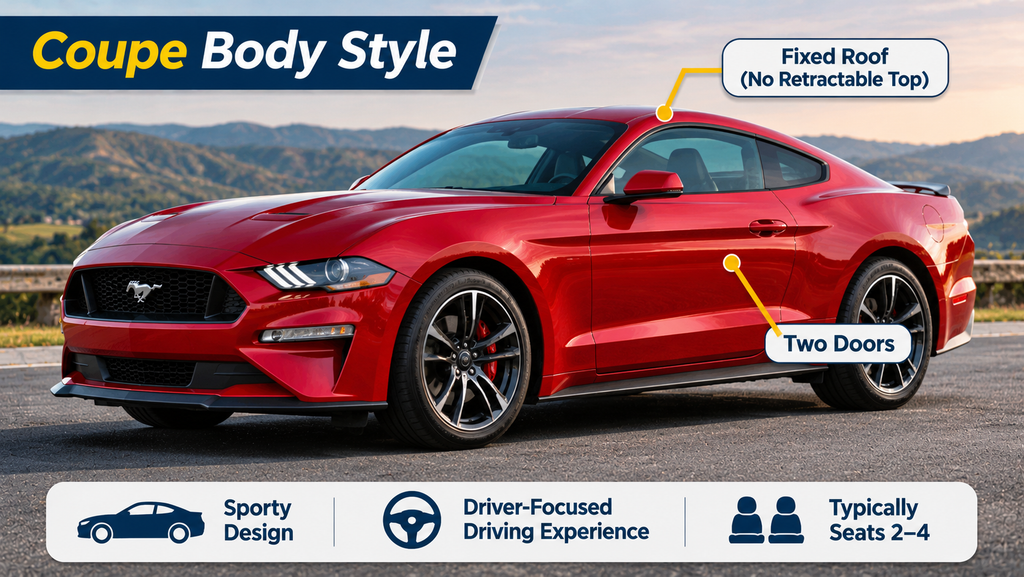
Coupe Advantages and Limitations
Coupes may appeal to drivers who prioritize styling and an engaging driving experience. Their main practical limitations can include rear-seat access, passenger space, and cargo capacity, depending on the vehicle.
Best suited for: Drivers seeking distinctive styling, especially when large cargo areas and frequent rear-seat access are not priorities.
4. Convertible Cars
A convertible is a vehicle with a roof that can be lowered, folded, or removed to allow open-air driving. Convertible roofs may be made from fabric, rigid panels, or retractable hardtop systems.
The Mazda MX-5 Miata is a well-known example of a compact two-seat roadster.
Convertibles appeal to drivers who enjoy open-air motoring, but they may have different weather protection, cargo space, noise levels, and roof maintenance requirements than fixed-roof alternatives.
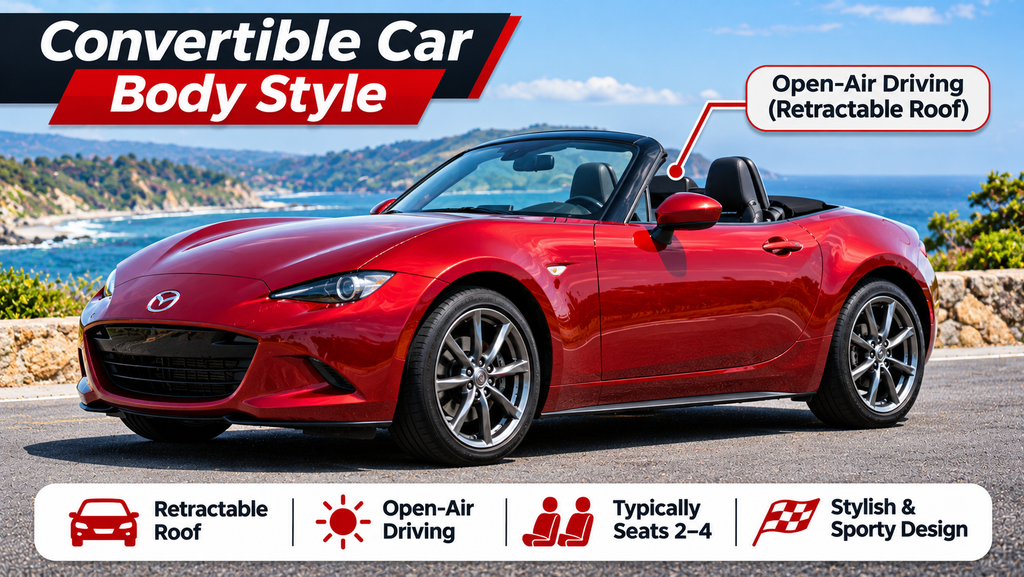
Best suited for: Drivers seeking distinctive styling, especially when large cargo areas and frequent rear-seat access are not priorities.
5. Station Wagons
A station wagon, also called an estate car in some markets, has an extended roofline and a rear cargo area accessed through a liftgate.
A wagon typically offers a passenger-car driving layout with additional enclosed cargo space behind the rear seats. The roof usually extends farther toward the back of the vehicle than on a conventional hatchback.
The Volvo V60 is an example of a modern wagon design.
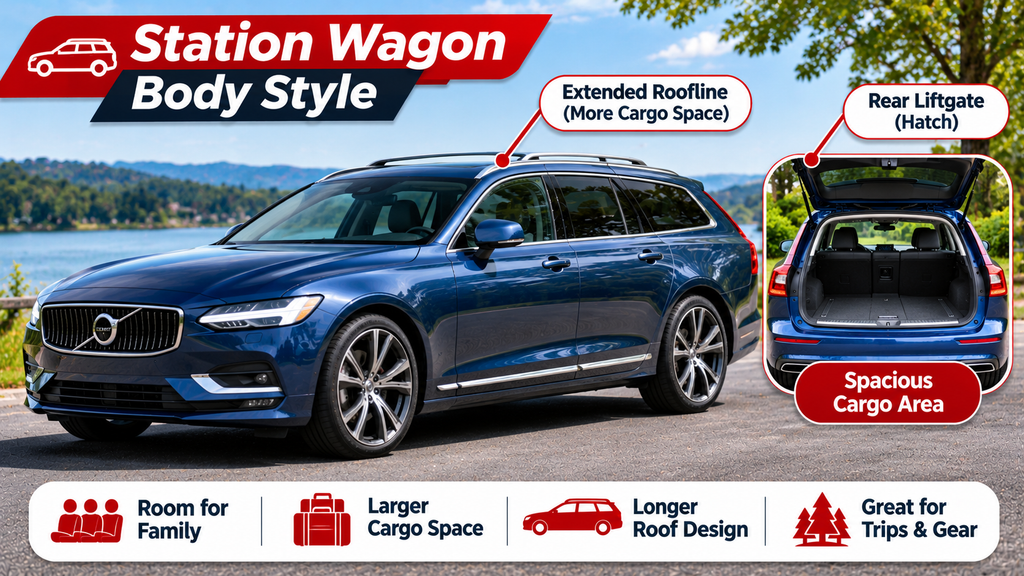
Wagon vs. Hatchback
Both body styles use a rear liftgate. However, wagons usually have a longer roof and an extended cargo area. Hatchbacks generally have a shorter rear body, although the boundaries between these designs can overlap.
Best suited for: Drivers wanting a traditional passenger-car shape with more flexible enclosed cargo space.
6. SUVs and Crossovers
An SUV stands for Sport Utility Vehicle. SUVs generally have a taller body, an elevated driving position, and a rear cargo area accessed through a liftgate.
They range from small urban models to large vehicles with three rows of seating. Some are designed mainly for paved roads, while others have specialized features for towing or off-road driving.
What Is a Crossover?
A crossover, sometimes called a CUV or crossover SUV, generally combines SUV-like proportions with unibody construction, where the body and main structural framework form an integrated design.
Traditional truck-based SUVs often use body-on-frame construction, where the body sits on a separate frame.
However, the distinction is not absolute. Many modern vehicles marketed as SUVs are unibody crossovers, and manufacturers frequently use the terms interchangeably.
The Honda CR-V is a familiar crossover example. The Toyota 4Runner illustrates a more traditional SUV design.
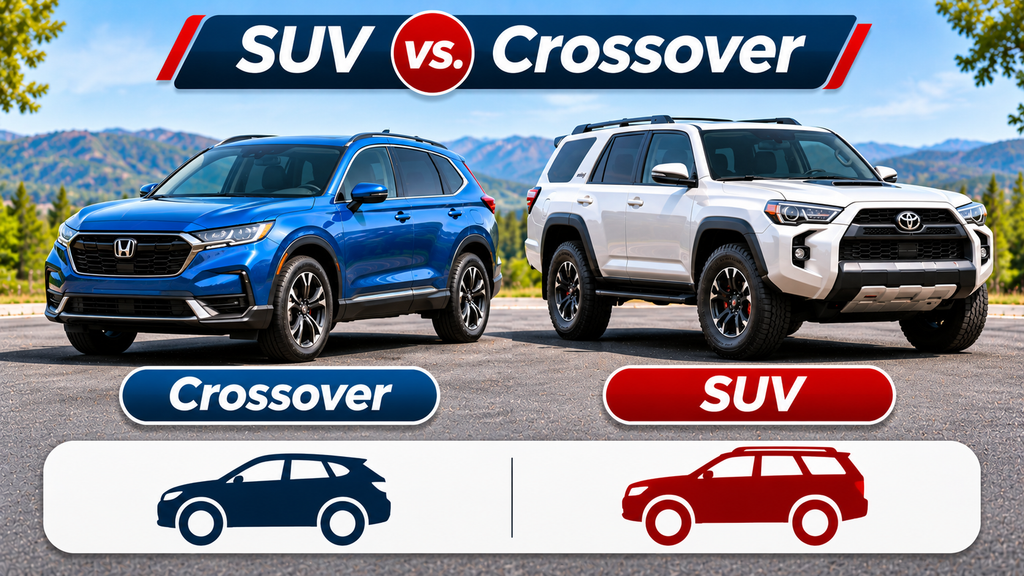
SUV vs. Crossover Comparison
| Feature | Crossover | Traditional SUV |
|---|---|---|
| Construction | Usually unibody | Often body-on-frame |
| Driving focus | Often everyday road comfort | May emphasize utility and ruggedness |
| Towing | Varies by model | Some models have higher ratings |
| Off-road use | Depends on equipment | Some models have specialized capability |
| Examples | Honda CR-V | Toyota 4Runner |
A crossover is not automatically unsuitable for rough roads, and a traditional SUV is not automatically better at every task. Compare the specific model’s tires, clearance, drivetrain, towing rating, and intended use.
7. Minivans
A minivan is a passenger vehicle designed to make family transportation and interior access convenient. Its defining features often include sliding side doors, multiple rows of seats, and a flexible cargo area.
The Toyota Sienna and Honda Odyssey are recognizable examples.
Sliding doors can be especially convenient in parking lots where there is limited room to swing open a conventional door. Many minivans also offer configurable seating and storage arrangements.
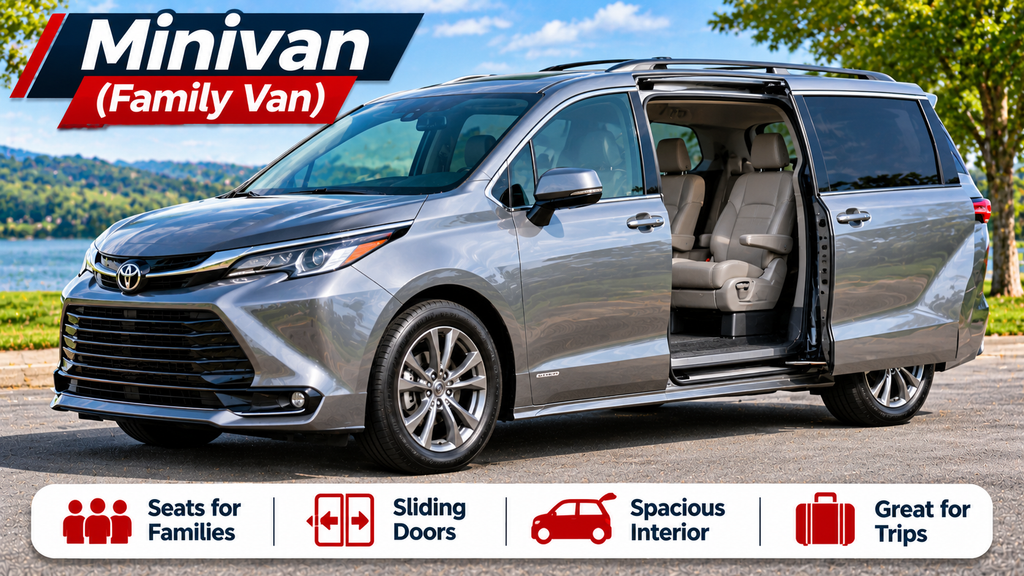
Best suited for: Families needing multiple seats, child-seat accessibility, and adaptable passenger or cargo configurations.
8. Pickup Trucks
A pickup truck is a vehicle with an enclosed passenger cab and an open cargo bed behind it.
Pickups are commonly used for transporting tools, equipment, building supplies, and outdoor recreation gear. They are included in broad vehicle-type guides even though they are not generally classified as passenger cars in the narrow sense.
The Ford F-150 and Toyota Tacoma are familiar pickup truck examples.
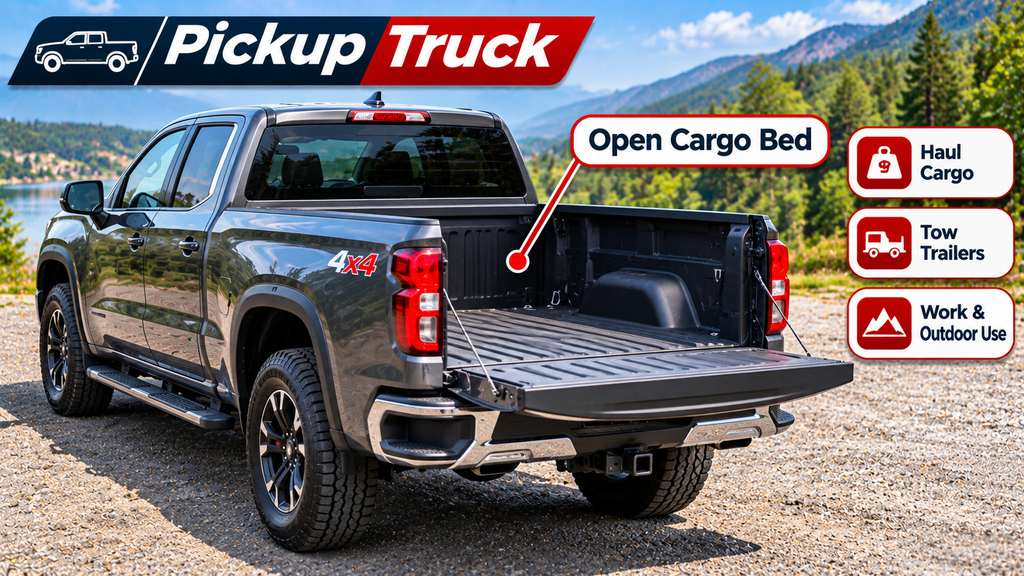
Before choosing a truck, consider its dimensions, payload rating, towing capacity, parking requirements, and typical loads. A truck’s rated capabilities vary considerably between configurations.
Other Popular Vehicle Categories
Some common car descriptions refer to a vehicle’s intended market, performance, or overall size instead of its basic body shape.
Sports Cars
Sports cars emphasize driving dynamics and performance. They may be coupes or convertibles. The Mazda MX-5 Miata and Chevrolet Corvette are recognizable examples, although their designs differ.
Luxury Cars
Luxury vehicles emphasize premium materials, comfort, technology, or refinement. Luxury cars may be sedans, SUVs, coupes, or other body styles.
City Cars
City cars are small vehicles intended primarily for urban practicality. Their compact dimensions may help with parking and navigating crowded streets.
Performance SUVs
Performance-oriented SUVs combine an SUV-like body with features designed for stronger acceleration or sharper driving responses. Their capability varies by model.
A car can belong to several categories. For example, a luxury electric SUV is classified by market positioning, powertrain, and body style simultaneously.
Types of Cars by Size
Vehicle size is another way to classify the different varieties of cars. Common everyday terms include subcompact, compact, midsize, and full-size.
| Size Class | General Description | Typical Consideration |
|---|---|---|
| Subcompact | Relatively small vehicle | Urban parking and maneuverability |
| Compact | Smaller mainstream size class | Balance of size and practicality |
| Midsize | Intermediate size category | Passenger room and everyday use |
| Full-size | Larger vehicle category | Interior room and overall dimensions |
These labels are useful for general comparisons, but their exact definitions can vary across vehicle categories, manufacturers, and regulatory systems. Always compare actual dimensions, seating capacity, and cargo measurements.
Types of Cars by Fuel and Powertrain
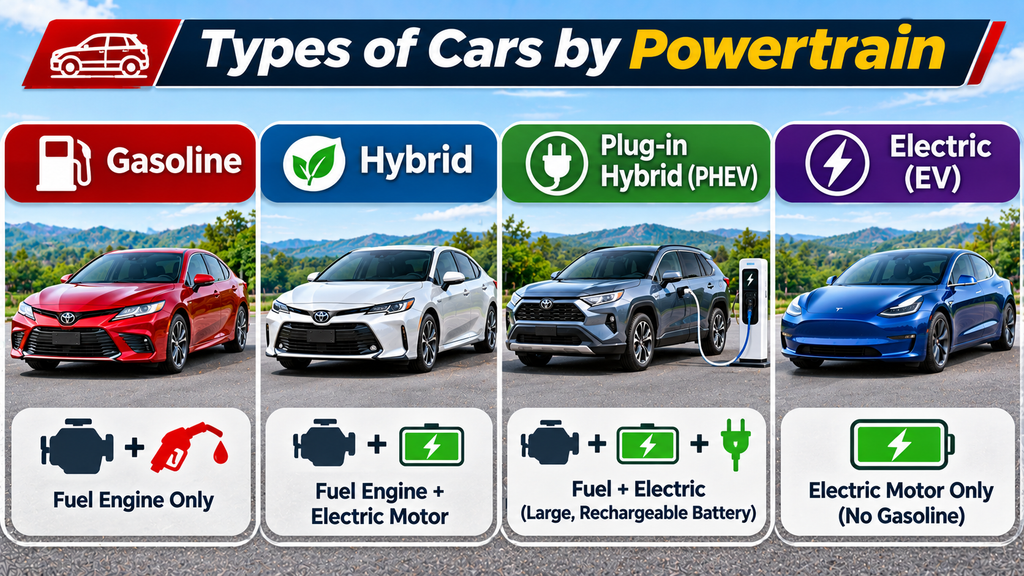
Not every classification describes the vehicle’s exterior design. Cars can also be grouped by how they produce and use power.
Gasoline and Diesel Vehicles
These vehicles use an internal combustion engine powered by gasoline or diesel fuel. They come in many different body styles, including sedans, SUVs, and pickups.
Hybrid Cars
Hybrid vehicles combine an internal combustion engine with an electric motor and battery system. Conventional hybrids generally do not require external charging.
Plug-In Hybrid Cars
Plug-in hybrids also combine an engine and electric propulsion, but they can recharge their traction batteries from an external power supply. Their electric-only capability varies.
Electric Cars
Battery-electric vehicles use electric motors powered by rechargeable batteries and do not have a gasoline engine providing propulsion.
An electric vehicle can be a sedan, hatchback, SUV, or pickup. Electric describes the powertrain, not the body style.
FWD, RWD, AWD, and 4WD
Another classification concerns which wheels receive driving power.
- FWD: Front-wheel drive.
- RWD: Rear-wheel drive.
- AWD: All-wheel drive.
- 4WD: Four-wheel drive, typically associated with systems intended for added traction in particular conditions.
AWD and 4WD terminology can overlap. The exact operation depends on the system installed in the vehicle.
Car Type Buying Checklist
- Passenger space: How many adults or children will regularly ride in the vehicle?
- Cargo needs: Will you transport luggage, groceries, strollers, tools, or bulky equipment?
- Parking: Will the vehicle fit comfortably in your garage or regular parking spaces?
- Driving conditions: Do you mostly travel on highways, city streets, or rough roads?
- Operating costs: Consider fuel or electricity, insurance, maintenance, and tires.
- Safety: Compare actual safety ratings, driver-assistance features, and crash-test information by model.
- Budget: Include purchase price, taxes, registration, financing, and expected ownership costs.
- Test drive: Check visibility, seat comfort, controls, and maneuverability.
Choosing a Car Type for Different Needs
| Driver Need | Types Worth Comparing | Why |
|---|---|---|
| Daily commuting | Sedan, hatchback | Practical passenger-car layouts |
| Small family | Sedan, crossover | Passenger and cargo flexibility |
| Large family | Minivan, three-row SUV | Additional seating options |
| Carrying equipment | Pickup, van, SUV | Different cargo arrangements |
| Open-air driving | Convertible | Retractable or removable roof |
| Frequent luggage transport | Wagon, hatchback, crossover | Accessible enclosed cargo areas |
Treat these suggestions as starting points. Compare real models and configurations before making a purchase.
Frequently Asked Questions About Types of Cars
1. How many different types of cars are there?
There is no single fixed number because cars can be categorized by body style, size, performance, powertrain, or purpose. Common body styles include sedans, hatchbacks, coupes, convertibles, wagons, SUVs, crossovers, and minivans. Broad vehicle lists often include pickups.
2. What are the most common types of cars?
Common everyday vehicle types include sedans, hatchbacks, SUVs, crossovers, pickups, and minivans. Their popularity varies by region and market, and each design serves different transportation needs.
3. What is the difference between a sedan and an SUV?
A sedan generally has a lower passenger-car body and a separate trunk. An SUV usually has a taller body, an elevated driving position, and a rear liftgate leading to a flexible cargo area.
4. Is a crossover the same as an SUV?
A crossover is generally an SUV-like vehicle built using unibody construction. Traditional SUVs often use separate body-on-frame construction. However, modern marketing uses the terms SUV and crossover interchangeably, and many modern SUVs are crossovers.
5. What is the difference between a coupe and a sedan?
A traditional coupe generally has two doors and a fixed roof, while a conventional sedan has four doors and an enclosed trunk. Some manufacturers use the term four-door coupe for sedan-like models with sporty rooflines.
6. What type of car is best for a family?
Minivans, SUVs, crossovers, and sedans can all be suitable family vehicles. The right choice depends on seating requirements, child-seat access, cargo space, budget, and the safety characteristics of the specific model.
7. Are electric cars a separate vehicle body style?
No. Electric describes how the vehicle is powered. Battery-electric vehicles can have sedan, hatchback, SUV, pickup, and other body styles.
8. What is the difference between a hatchback and a wagon?
Both have a rear liftgate, but a wagon generally has a longer roofline extending toward the back of the vehicle and an elongated cargo area. A hatchback usually has a shorter rear body. Some designs blur the distinction.
Final Thoughts: Understanding Different Types of Cars
Understanding the different types of cars helps make vehicle terminology easier to recognize. Sedans, hatchbacks, coupes, wagons, SUVs, crossovers, minivans, and pickups each have recognizable design features and practical purposes.
Remember that body styles are only one way to classify vehicles. Size, drivetrain, powertrain, performance, and market positioning describe other characteristics that may overlap with those body styles.
Key takeaway: The best type of car is the one that meets your actual needs. Compare passenger comfort, cargo flexibility, dimensions, ownership costs, and verified model-specific features rather than choosing solely by vehicle category.