
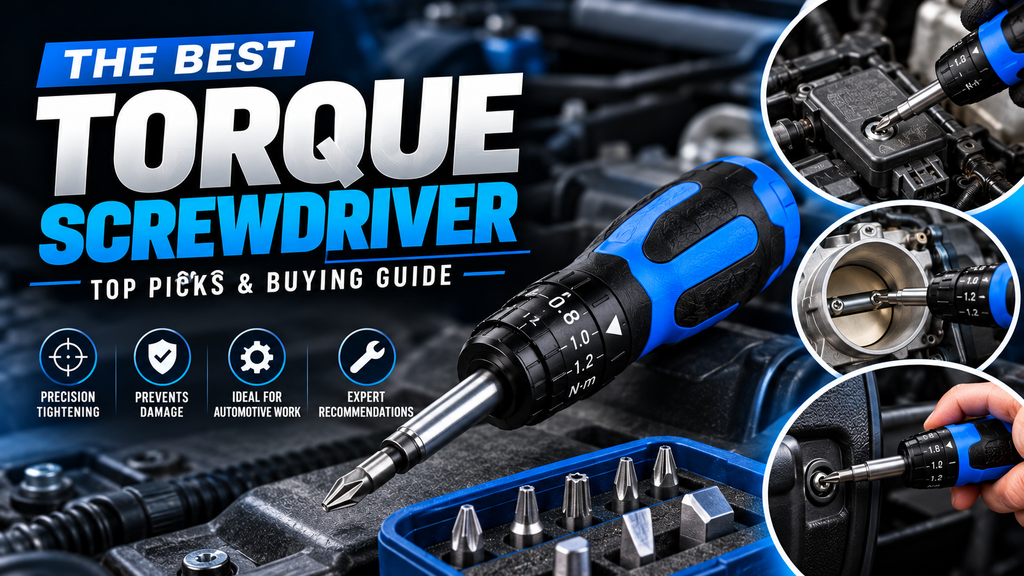
A tiny screw can cause a surprisingly expensive problem. Tighten it too much and you might strip the threads, crack a housing, or damage a delicate component. Leave it too loose and the assembly may not stay secure.
That’s where a torque screwdriver becomes useful. Unlike an ordinary screwdriver, a torque-controlled model helps you apply a specified amount of rotational force.
But the best torque screwdriver isn’t necessarily the most expensive one. It depends on the torque range you need, how frequently you use the tool, and whether you’re working on automotive electronics, small assemblies, or professional equipment.
This guide compares five manufacturer-documented options and explains how to select, adjust, and use torque screwdrivers correctly.
What Is the Best Torque Screwdriver?
For versatile work requiring 5–40 in-lb, the Klein Tools 57032 is a strong option thanks to its broad range, included bits, storage case, and NIST-traceable calibration certificate.
For lower-torque precision applications, the Wera 7430, 7440, and 7441 offer more specialized ranges.
The GEARWRENCH 89624 is another practical choice for 10–50 in-lb applications.
Before buying: Confirm that your required tightening specification falls within the tool’s working range.
5 Best Torque Screwdrivers to Consider
These options cover different working ranges and use cases. The recommendations are based on published manufacturer features rather than independent hands-on testing.
Check the exact model and included accessories before ordering because different versions of a tool may have different specifications.
1. Klein Tools 57032 Torque Screwdriver Set
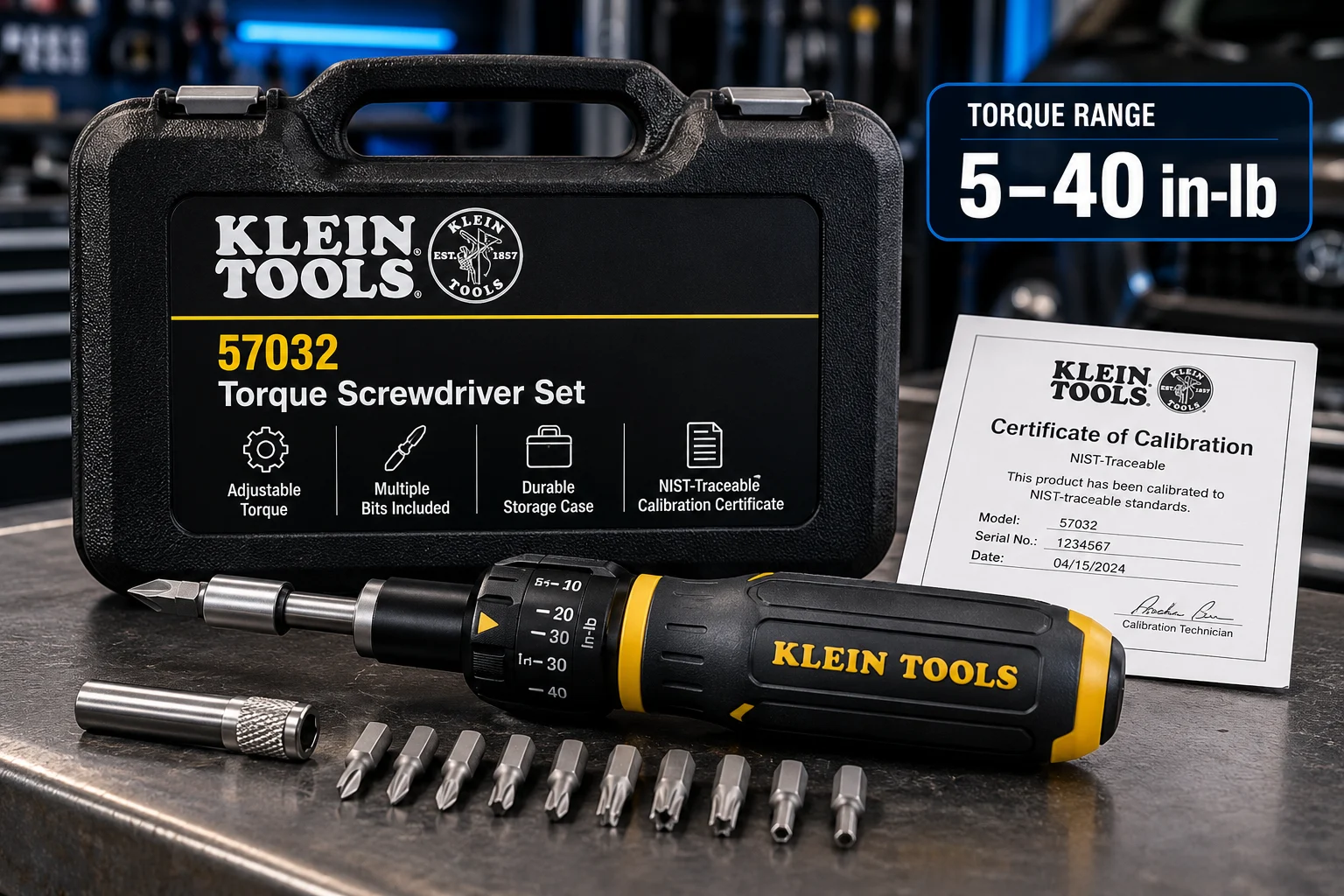
The Klein Tools 57032 makes sense for users who need one adjustable tool for several small fastening jobs. Its 5–40 in-lb working range covers a useful selection of specified low-torque applications.
The set includes screwdriver bits, a storage case, and a NIST-traceable calibration certificate. Its textured, tri-lobular handle is designed for a secure grip.
Best for: DIY and professional users who need a versatile torque screwdriver set.
2. GEARWRENCH 89624 Torque Screwdriver
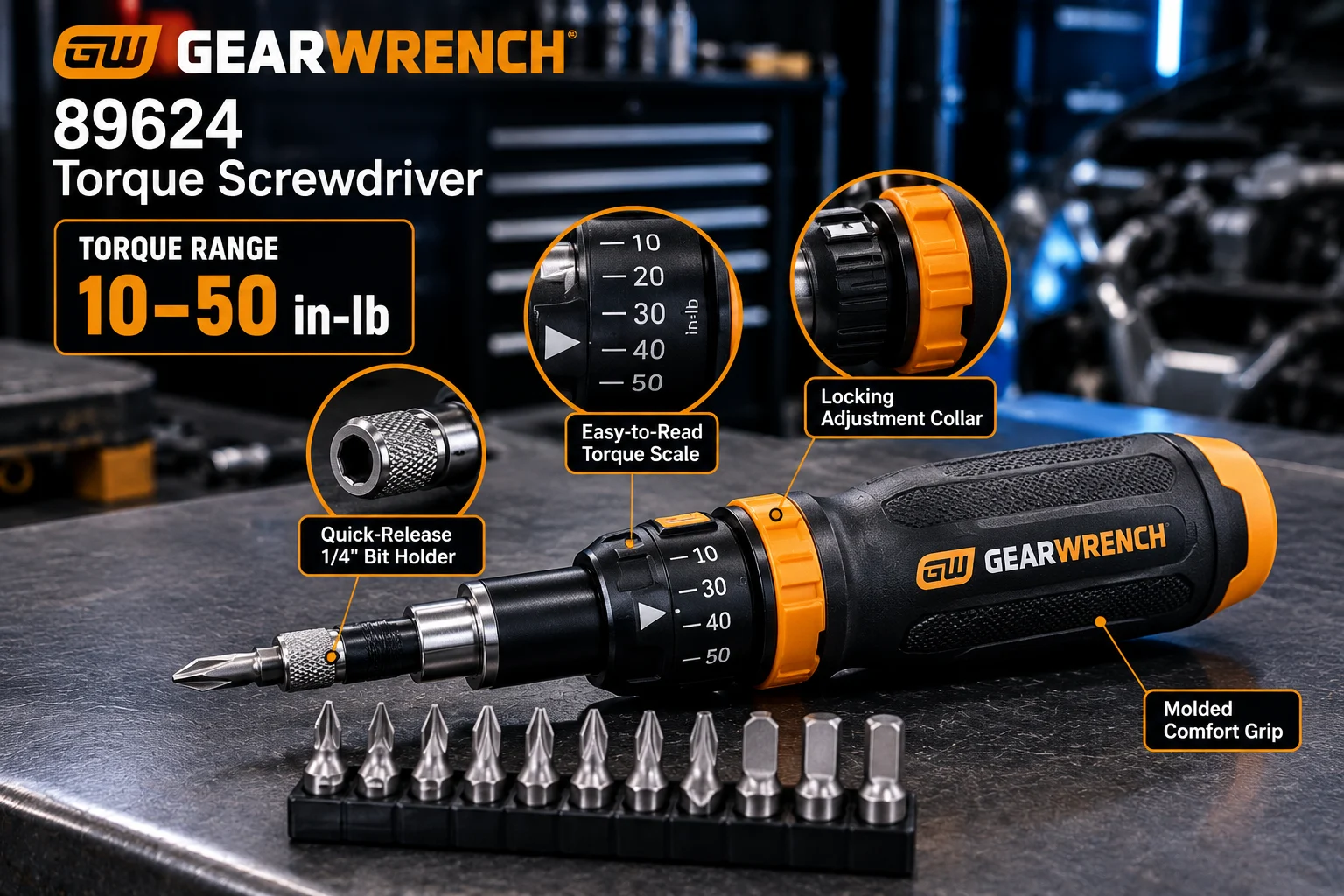
The GEARWRENCH 89624 is worth considering for tasks requiring somewhat higher tightening values. It features a locking adjustment collar, readable scale, quick-release 1/4-inch bit holder, and molded comfort grip.
GEARWRENCH publishes a clockwise accuracy specification of ±6% and identifies the tool for electrical service and assembly applications.
Best for: Users needing controlled fastening between 10 and 50 in-lb.
3. Wera 7430 Kraftform Torque Screwdriver
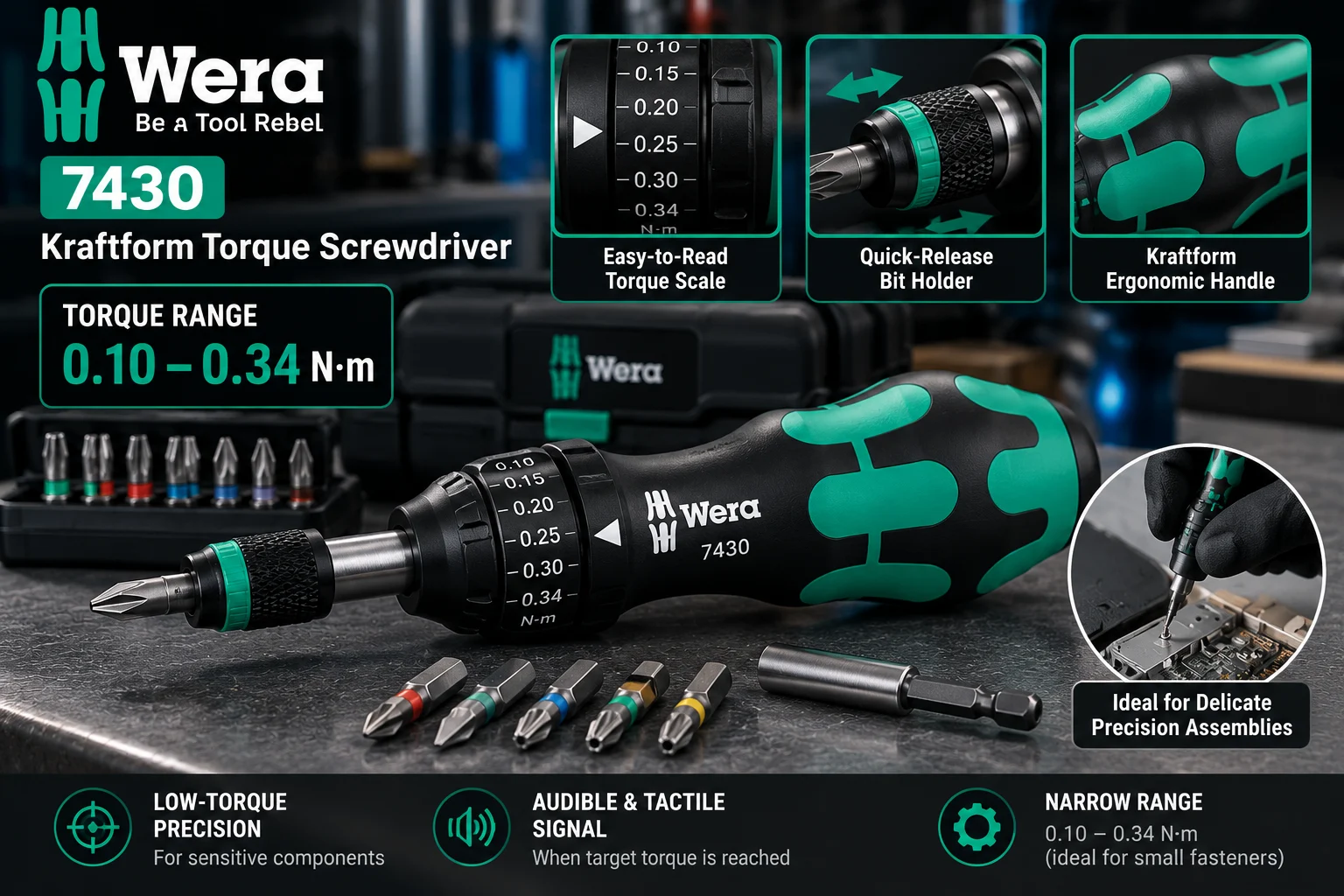
The Wera 7430 is a specialized option for very small torque requirements. Its narrow adjustment range allows users to select values that many general-purpose torque screwdrivers cannot cover.
It has an easy-to-read scale, a quick-release bit holder, and an audible and tactile signal when the preset value is reached.
Best for: Delicate assemblies with manufacturer-specified low tightening values.
4. Wera 7440 Kraftform Torque Screwdriver
The Wera 7440 offers a useful middle ground between very-low-torque work and broader workshop fastening. It provides adjustable torque, an audible release signal, and Wera’s Rapidaptor bit holder.
The manufacturer states an accuracy of ±6% for this model under its published testing standard.
Best for: Small mechanical and electronics-related assemblies where the specified torque falls within its range.
5. Wera 7441 Kraftform Torque Screwdriver
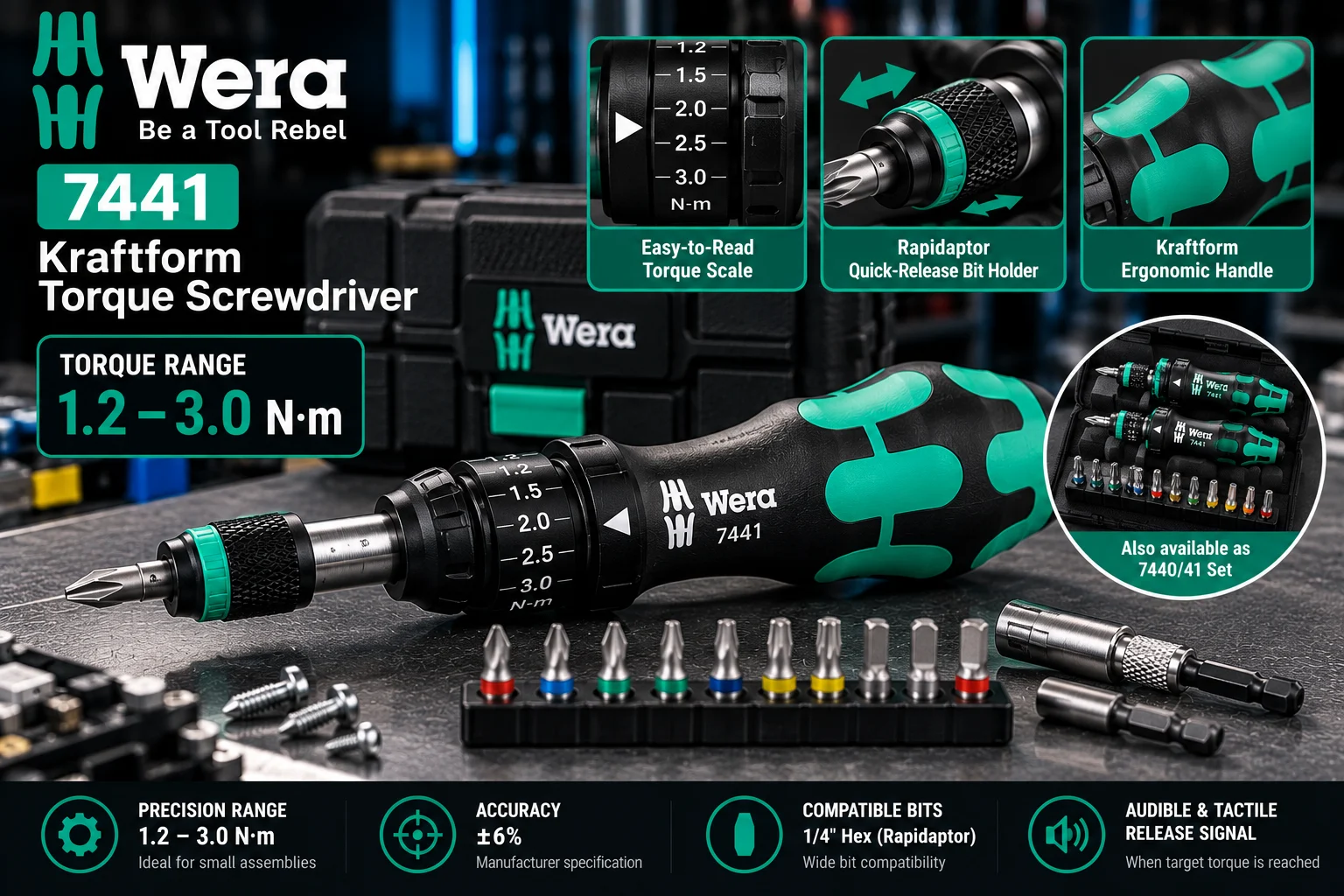
If the 7440 does not reach the required setting, the Wera 7441 covers the next range up. It uses a similar adjustable design, ergonomic handle, and quick-release bit holder.
It’s also available as part of Wera’s 7440/41 set, which combines both ranges and includes an assortment of bits.
Best for: Users working with metric torque specifications in the 1.2–3.0 N·m range.
Selection note: There is no universal winner for every fastener. First match the manufacturer’s tightening value, then compare accuracy, bit compatibility, ergonomics, and tool quality.
Torque Screwdriver Comparison Table
| Model | Torque Range | Best Application | Key Advantage |
|---|---|---|---|
| Klein Tools 57032 | 5–40 in-lb | Versatile workshop jobs | Set and calibration certificate |
| GEARWRENCH 89624 | 10–50 in-lb | Higher-range small fasteners | Locking collar and clear scale |
| Wera 7430 | 0.10–0.34 N·m | Very low torque | Fine low-range adjustment |
| Wera 7440 | 0.3–1.2 N·m | Lower-range precision | Rapidaptor bit holder |
| Wera 7441 | 1.2–3.0 N·m | Metric small assemblies | Complementary working range |
Specifications are manufacturer-published. Check the current product datasheet for the exact model before purchasing.
What Is a Torque Screwdriver?
A torque screwdriver is a precision fastening tool designed to apply, limit, or indicate a particular tightening torque, depending on its mechanism.
An ordinary screwdriver relies on the user’s judgment. A torque-limiting screwdriver instead has a mechanism that signals or releases when its selected tightening value is reached.
That makes it particularly useful when a service manual specifies how tightly a small screw should be fastened.
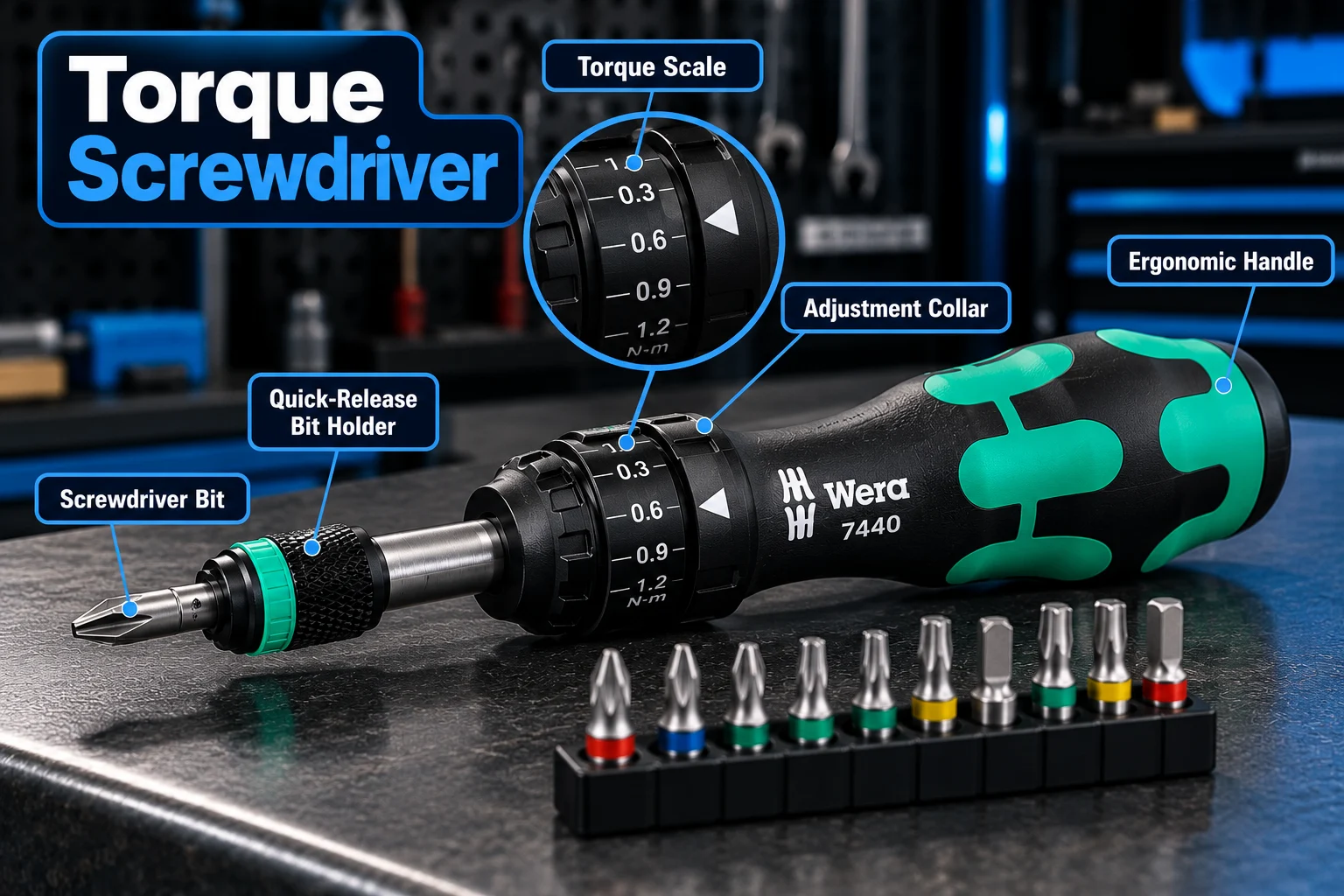
Adjustable Torque
The user selects a setting within the manufacturer’s rated range.
Controlled Tightening
A release or indicating mechanism helps the user recognize the target torque.
What Is a Torque Screw?
A torque screw isn’t usually a special type of screw. The term is sometimes used to describe a screw that must be tightened to a specific torque value.
Torque is the turning force applied when tightening or loosening a fastener. Too much torque can damage threads, crack components, or break a screw. Too little torque may leave the connection insufficiently secured.
For example, an automotive component manufacturer might specify that a particular screw must be tightened to 8 in-lb. That value is only an example of a tightening specification, not a recommendation for every screw.
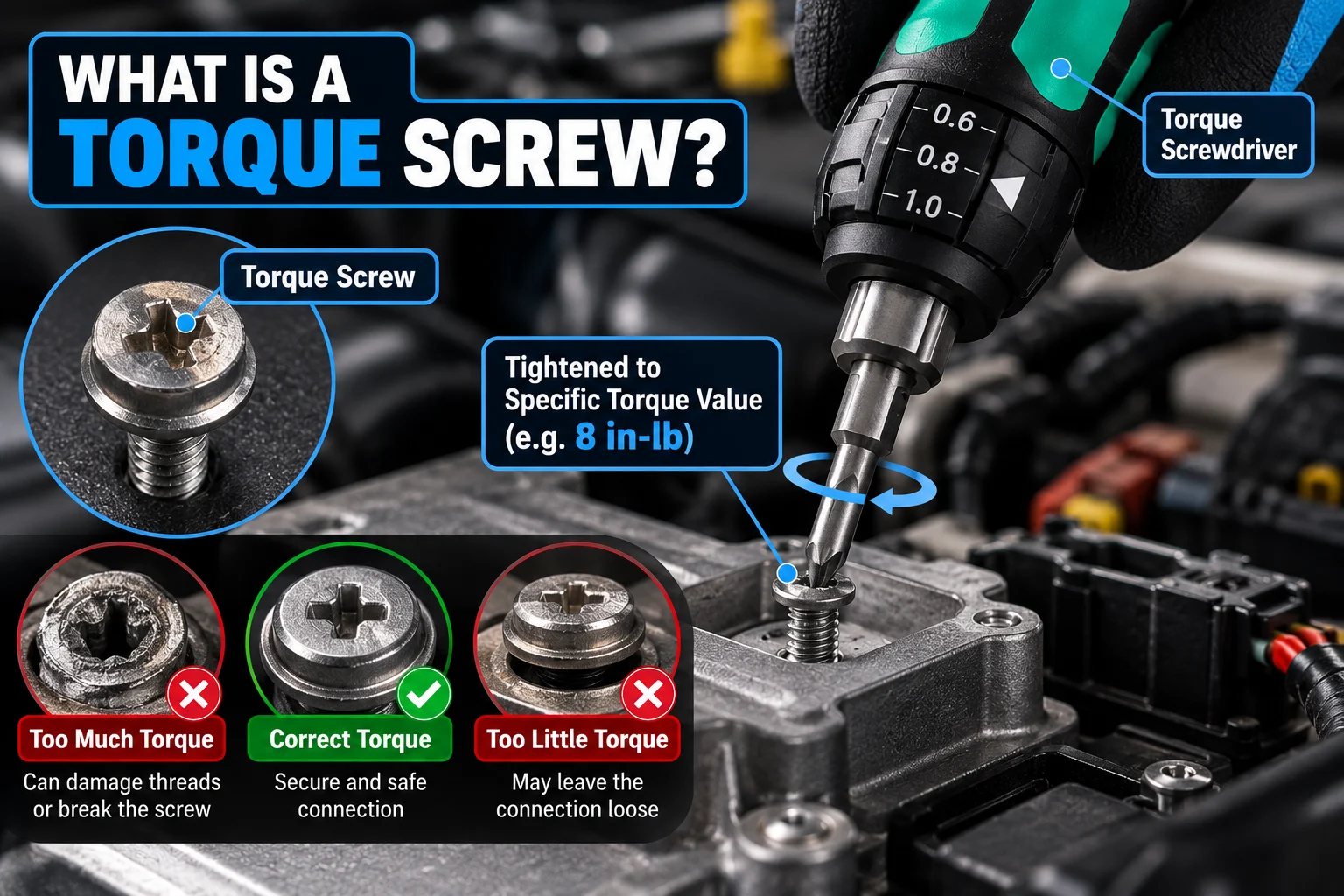
Regular Screw
A threaded fastener used to join or secure components. Its required tightening torque depends on the fastener, material, and application.
Torque Screwdriver
A precision tool used to apply, limit, or indicate tightening torque according to the required setting and the tool’s design.
Important distinction: A screw is the fastener, torque is the turning force, and a torque screwdriver is the tool used to control that force.
Torque Screw vs. Torx Screw: What’s the Difference?
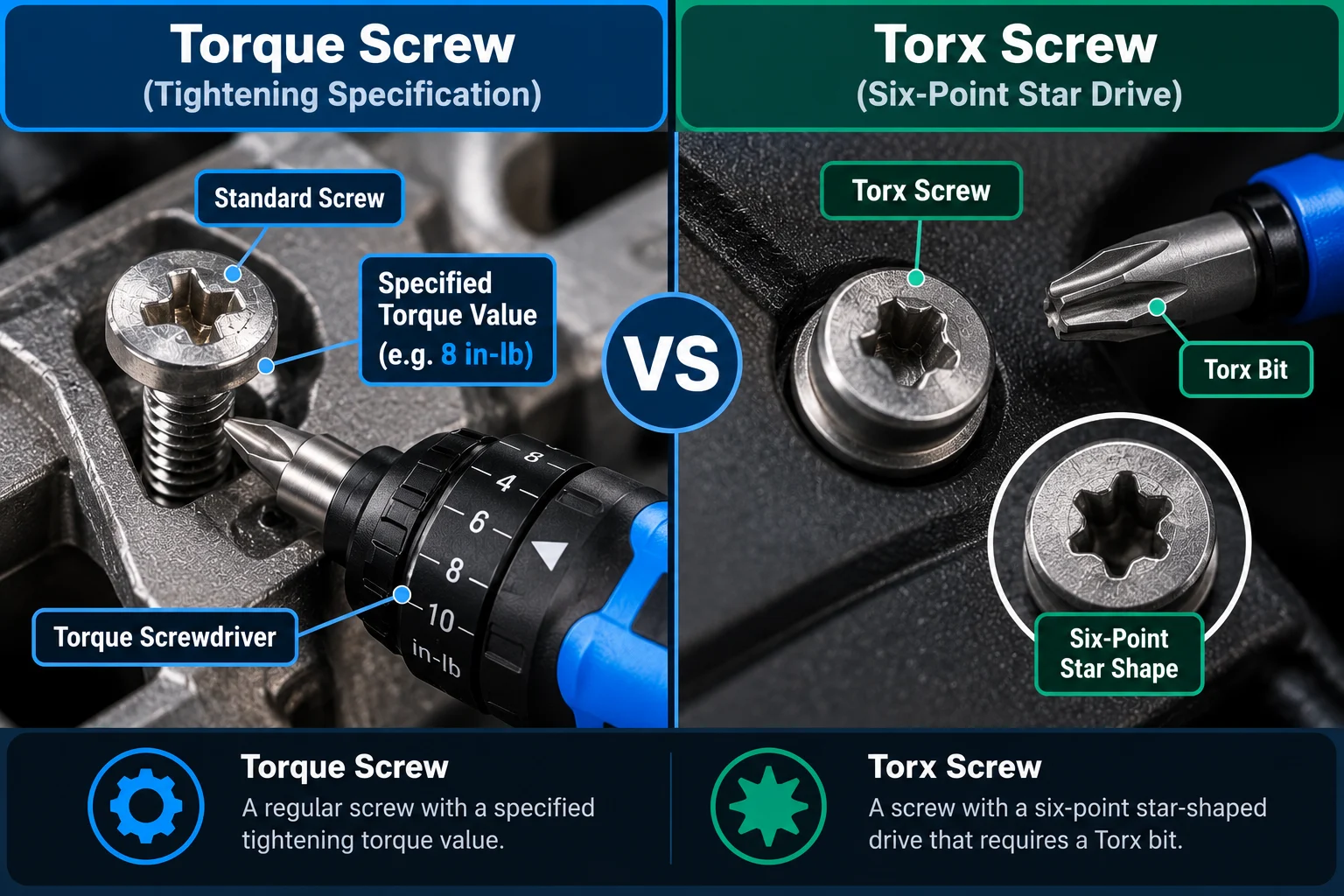
These terms are often confused. A Torx screw has a six-point star-shaped drive designed to accept a matching Torx bit.
Torque, however, refers to turning force. A Torx screw may have a specified tightening torque, just like a Phillips, hex, or other fastener.
A torque screwdriver can tighten different screw-drive types when equipped with the correct compatible bit and used within its rated range.
Types of Torque Screwdrivers
Not all torque screwdrivers work the same way. The most common categories include:
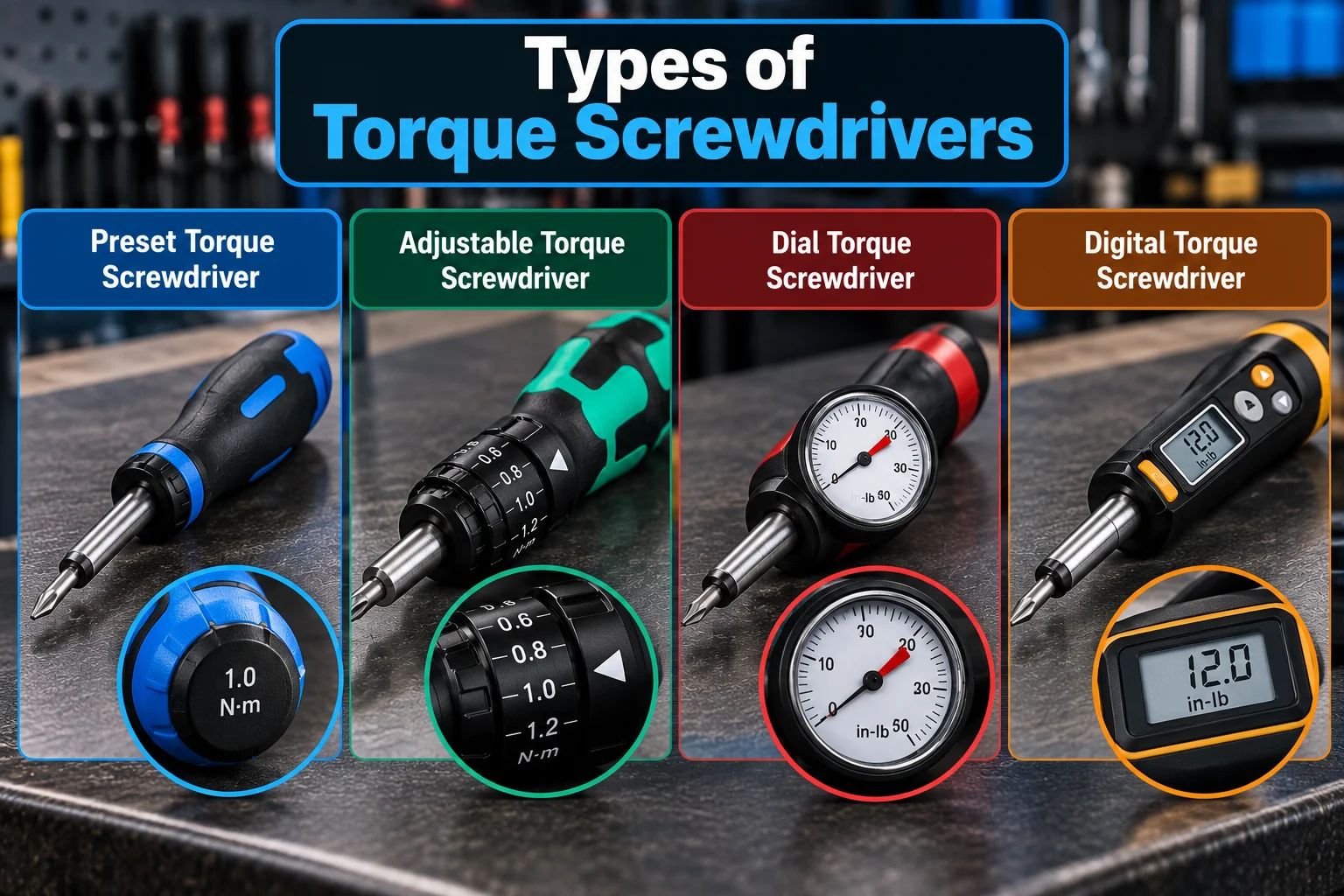
Mechanical Adjustable
Uses an adjustable setting and mechanical torque indication or limiting mechanism. Good for varied tightening requirements.
Preset
Configured for a particular torque value, often for repetitive assembly work where consistency matters.
Digital
Measures or indicates torque electronically. Some provide alerts, although not every digital model automatically limits torque.
Low-Torque Precision
Designed for small fastening values that fall below the working range of many standard models.
How to Choose the Best Torque Screwdriver
A good purchase starts with the fastener, not the tool’s appearance or maximum torque rating.
Choose the Correct Torque Range
The required tightening value must fall within the screwdriver’s rated range. For repeated precision work, avoid choosing a tool simply because the required value sits at its extreme limit.
Check Accuracy and Calibration
Look for a published accuracy specification, relevant calibration documentation, and manufacturer guidance about verification or servicing.
Check the Bits
Make sure the tool accepts the bit style and size required by the fastener. A poor-fitting bit can damage the screw head even when torque is controlled.
Consider Comfort and Frequency of Use
A comfortable grip and clear adjustment scale make frequent work easier. An occasional DIY user may prioritize versatility, while a professional may value repeatability and calibration support.
Torque Screwdriver Unit Converter
Torque specifications are often written in inch-pounds, newton-meters, or inch-ounces. Use this compact converter to compare the units shown in service instructions with those on your tool.
Convert Torque Units
Enter a torque value to see the equivalent measurements.
Unit conversion only. Always follow the required specification and use a properly rated tool.
Example: A specification of 10 in-lb equals approximately 1.13 N·m. These are torque values, not measurements of screw size.
How to Set Torque on a Screwdriver
The exact procedure varies by manufacturer, but the basic process is similar for most adjustable mechanical torque screwdrivers.
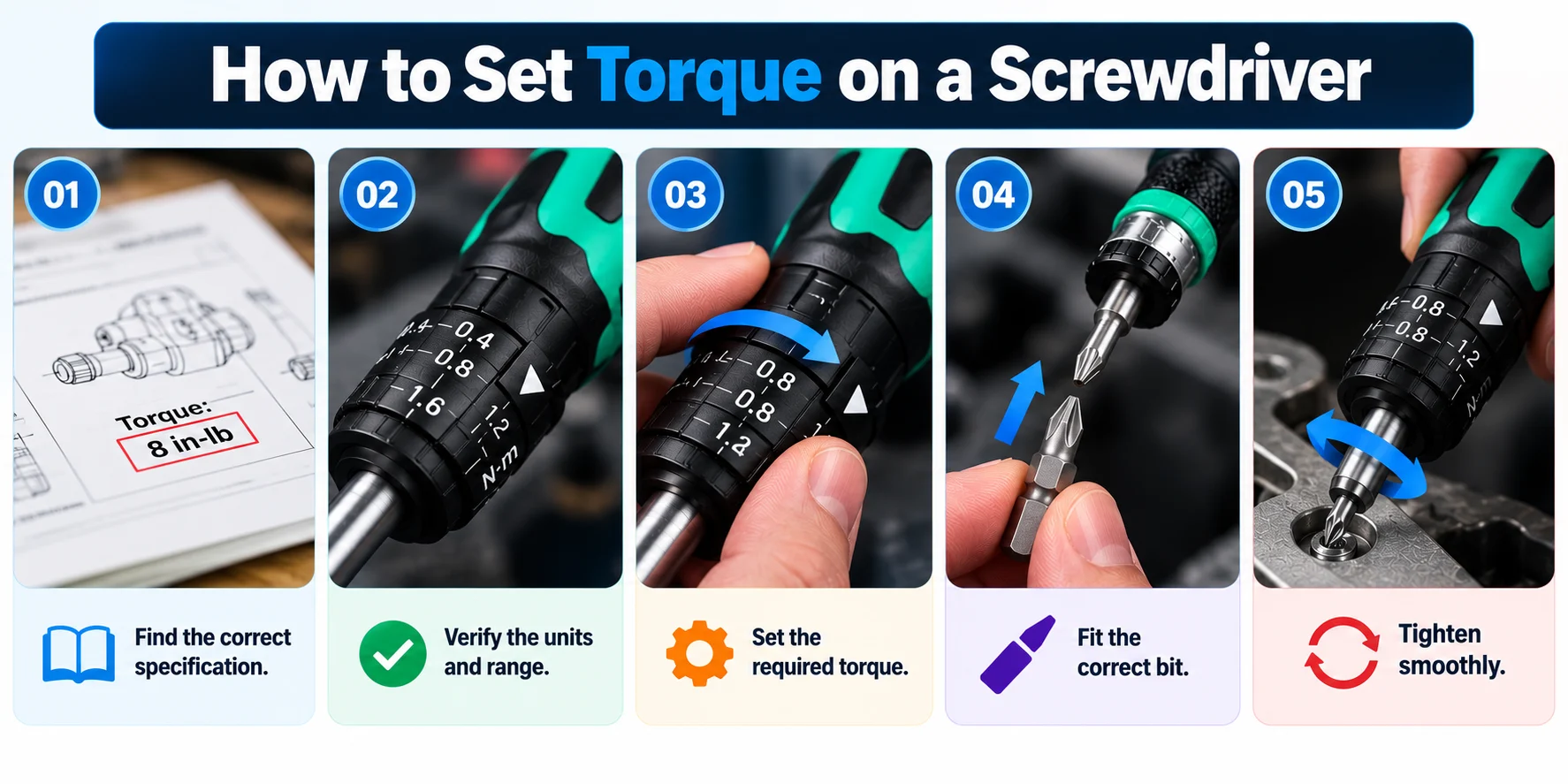
Use the tightening value published for the specific fastener or assembly.
Confirm that the value is within the screwdriver’s rated operating range.
Adjust the scale and secure any locking mechanism according to the manual.
Use a bit that engages the screw head securely and without excessive play.
Maintain suitable alignment and stop at the specified release, click, or indication.
Important: Do not repeatedly continue tightening after the limiting mechanism releases. Follow the tool’s instructions, particularly when working with delicate or safety-critical components.
Torque Screwdriver vs. Torque Wrench
Both tools help control fastening torque, but they’re commonly designed for different applications.
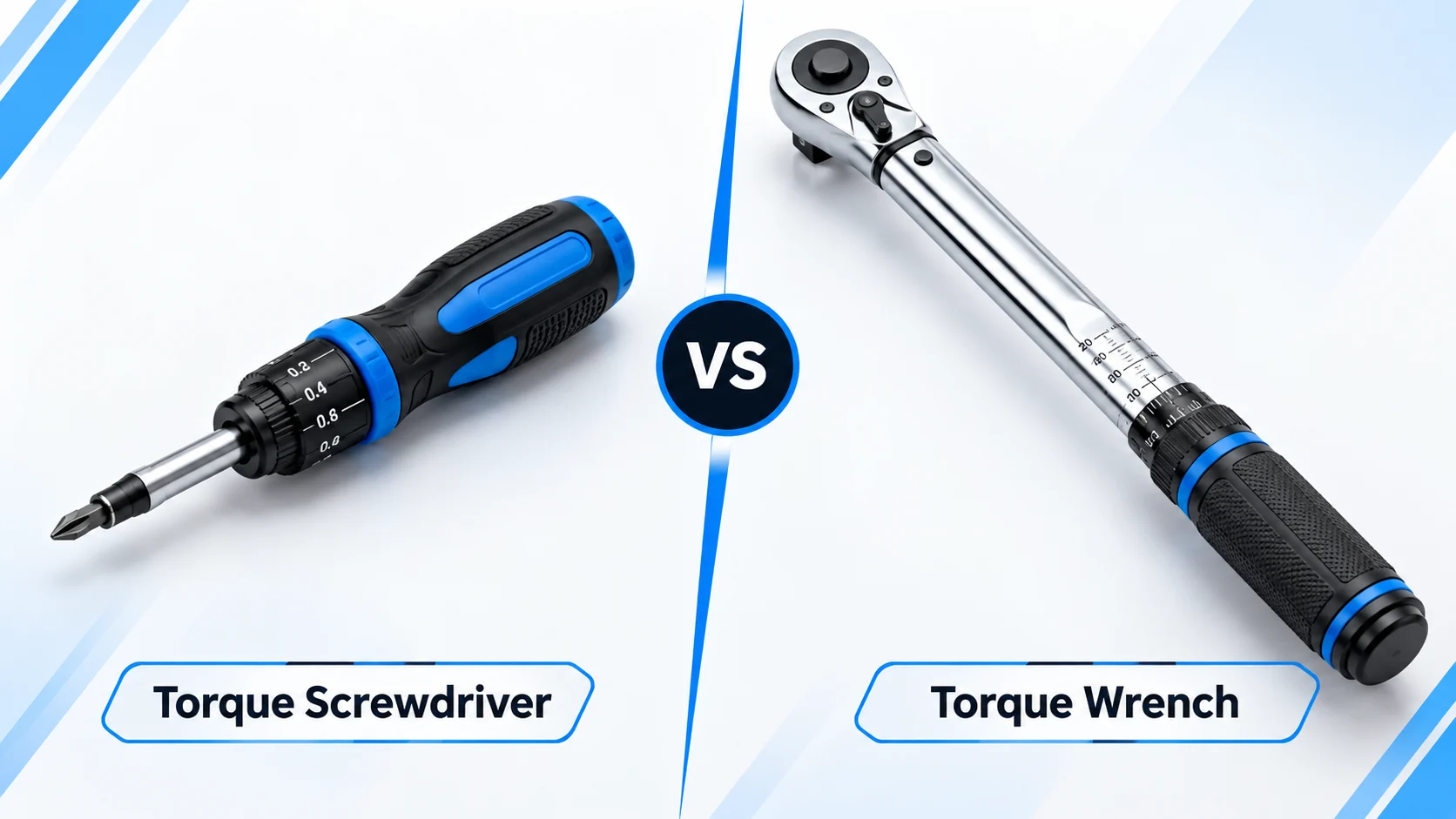
| Feature | Torque Screwdriver | Torque Wrench |
|---|---|---|
| Typical purpose | Small specified-torque fasteners | Socket-driven fasteners |
| Usual design | Screwdriver handle and bit holder | Lever handle and socket drive |
| Typical torque needs | Often lower ranges | Often higher ranges |
| Tool selection | Always follow the manufacturer’s required torque and tool instructions. | |
For wheel fasteners, major suspension components, and many engine bolts, a properly rated torque wrench is generally the relevant tool. A small torque screwdriver is not a substitute.
Where Are Torque Screwdrivers Used in Automotive Work?
Torque screwdrivers can be useful for smaller vehicle-related assemblies where the manufacturer provides an appropriate tightening specification.
Potential applications include certain electronic module housings, accessory assemblies, small mounting brackets, and precision components.
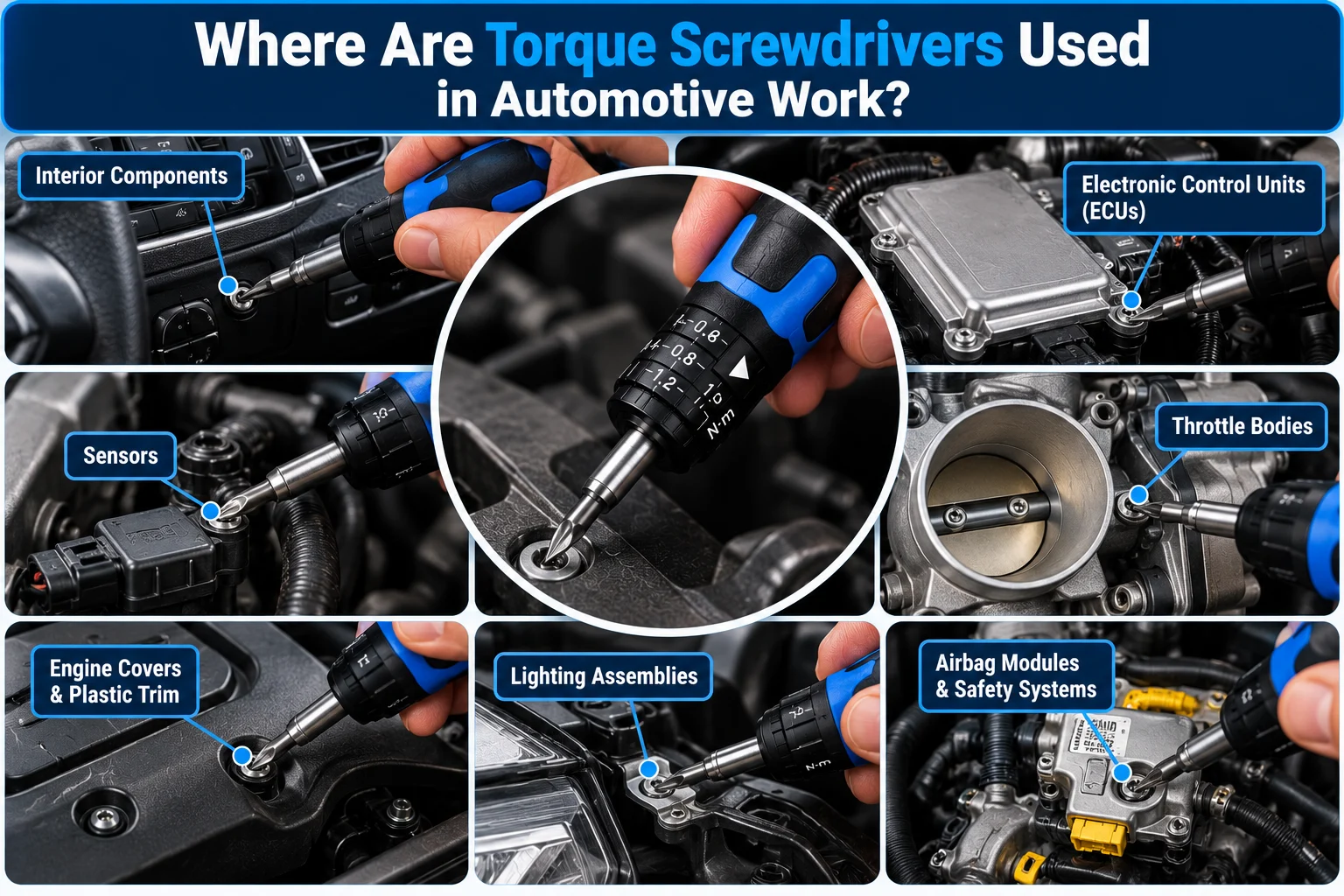
The key is to avoid assuming that every small automotive screw needs the same torque. Plastic housings, metal threads, inserts, and different fastener designs can have very different requirements.
Practical rule: A torque screwdriver should follow the service specification, not replace it. Never invent a tightening value based solely on screw size.
Common Torque Screwdriver Mistakes and Maintenance Tips
| Common Mistake | Better Approach |
|---|---|
| Confusing in-lb with ft-lb | Double-check the units before setting torque |
| Using a tool outside its range | Match the range to the specified value |
| Using an incorrect bit | Choose the exact drive and proper size |
| Ignoring calibration | Follow manufacturer verification guidance |
| Continuing after clutch release | Stop when instructed by the tool manufacturer |
Keep the screwdriver clean, inspect the bit holder, and store the tool away from unnecessary impacts. Follow the manufacturer’s instructions for storage settings and calibration intervals.
If the tool has been dropped or its torque accuracy is in doubt, have it checked before relying on it for precision work.
Frequently Asked Questions
What is the best torque screwdriver for beginners?
A suitable beginner option should have an adjustable range that covers the intended fasteners, clear settings, compatible bits, and documented accuracy. The Klein Tools 57032 is worth considering when the application requires 5–40 in-lb.
What is a torque screw?
A torque screw usually refers informally to a screw that has a specified tightening torque. It is not generally a separate screw-head design. The torque value depends on the fastener and application.
Is a torque screw the same as a Torx screw?
No. Torque describes turning force, while Torx describes a six-point star-shaped screw-drive system. Torx fasteners may also have specific tightening torque requirements.
Can a torque screwdriver prevent overtightening?
A properly set torque-limiting screwdriver can reduce overtightening risk, but only when used correctly with the appropriate specification. It cannot compensate for damaged threads, incorrect fasteners, or improper technique.
How do you adjust torque on a screwdriver?
Follow the manufacturer’s adjustment procedure, select the required value within the rated range, secure the setting if applicable, and stop tightening at the specified tool indication.
Are digital torque screwdrivers better?
Digital models may provide useful displays and feedback, but they are not automatically more accurate. Compare the actual accuracy specification, measurement range, operating mode, and calibration requirements.
Do torque screwdrivers need calibration?
Precision torque tools may require periodic calibration or verification according to the manufacturer’s guidance and usage conditions. Calibration is particularly important when a fastening specification must be met reliably.
Final Thoughts
The best torque screwdriver is the one that matches your fastening requirements—not simply the model with the highest maximum torque.
For broad-range work, the Klein Tools 57032 and GEARWRENCH 89624 are useful options to compare. For lower-torque precision applications, Wera’s 7430, 7440, and 7441 offer more specialized working ranges.
Before choosing: Check your required torque, verify the units, compare documented accuracy, and confirm bit compatibility. The right tool makes controlled fastening more predictable and helps protect delicate components.